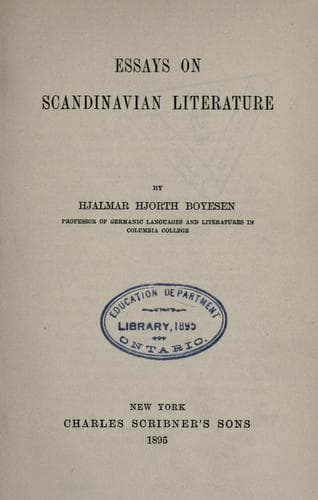
Essays on Scandinavian LiteratureBoyesen, Hjalmar Hjorth
History
Essays on Scandinavian Literature
Boyesen, Hjalmar Hjorth
Authors, Scandinavian; Scandinavian literature -- History and criticism
For all that, Tegner's doctrine was in its effect wholesome. It
discouraged the writers of the Romantic School, who under the guise of
profundity gave publicity to much immature and confused thinking. He was
no doubt right in saying that "a poetry which commences with
whooping-cough is likely to end in consumption." His frequently repeated
maxim, that poetry is nothing but the health of life, "occasioned by an
abounding intellectual vigor, a joyous leap over the barriers of
everyday life," applied, however, to his own poetry only so long as his
vigor was unimpaired. His terrible poem "Hypochondria" (_Mjeltsjukan_)
is to me no less poetical because it is not "a petrified drop of
heavenly light," and mocks all the cheerful theories of its author's
prime.
Tegner had yet a few years in which to rejoice in this "health of life"
in which he found the inspiration for his song; and these last years
were the most fruitful in his entire career. He was about forty years of
age when, in 1820, he began to compose the first cantos of "Frithjof's
Saga." He was living in modest comfort, happy in his marital relation,
and surrounded by a family of children to whom he was a most
affectionate father. He could romp and play with his curly-headed boys
and girls without any loss of dignity; and they loved nothing better
than to invade his study. Next to them in his regard was a black-nosed
pug, named Atis, who invariably accompanied him to his lectures and
remained sitting at his feet listening with intelligent gravity to his
explanations of the Greek poets. If by chance his master, in his zeal
for his own poetry, forgot the lecture-hour, Atis would respectfully
pull him by the tails of his coat. No man at the University of Lund was
more generally beloved than Tegner, and all honors which the University
could bestow had been offered to him. The office of Rector Magnificus he
had, however, persisted in declining.
Public-domain text, read in full here on John Shaqi.
Reviews
Reviews
No reviews yet
Be the first to share your thoughts on this work.
Elsewhere in the archive
Join the Discussion
Join the discussion
Sign in to leave a comment or review.
Sign InorCreate an account