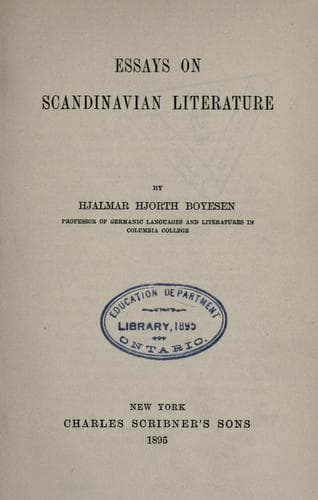
Essays on Scandinavian LiteratureBoyesen, Hjalmar Hjorth
History
Essays on Scandinavian Literature
Boyesen, Hjalmar Hjorth
Authors, Scandinavian; Scandinavian literature -- History and criticism
Ingeborg is shut up in Balder's Grove, where the sanctity of the temple
would make it sacrilege for any one to approach her. Frithjof, however,
braves the wrath of the god, and sails every night across the fjord to a
stolen rendezvous with his beloved. The canto called "Frithjof's
Happiness," which is brimming over with a swelling redundance of
sentiment, is so cloyingly sweet that the reader must himself be in love
in order to enjoy it. It is written in the key of the watch-songs of the
German minnesingers and the aubades of Provencal troubadours. The Norse
note is not only wanting, but would never fit into that key:
"'Hush! 'tis the lark.' Nay, those soft numbers
Of doves' faith tell that knows no rest.
The lark yet on the hillside slumbers
Beside his mate in grassy nest.
To them no king seals his dominions
When morning breaks in eastern air;
Their life is free as are their pinions
Which bear aloft the gladsome pair.
"'See day is breaking!' Nay, some tower
Far eastward sendeth forth that light;
We yet may spend another hour,
Not yet shall end the precious night.
May sleep, thou sun, thee long encumber,
And waking may'st thou linger still,
For Frithjof's sake may'st freely slumber
Till Ragnaroek, be such thy will.
"Vain hope! The day its gray discloses,
Already morning breezes blow,
Already bend the eastern roses,
As fresh as Ingeborg's can glow;
The winged songsters mount and twitter
(The thoughtless throng!) along the sky,
And life starts forth, and billows glitter,
And far the shades and lover fly.
* * * * *
"Farewell, beloved: till some longer
And fairer eve we meet again.
By one kiss on thy brow the stronger
Let me depart--thy lips, once, then!
Sleep now and dream of me, and waken
When mid-day comes, and faithful tell
The hours as I yearn forsaken,
And sigh as I! Farewell, farewell!"[38]
[38] Translation of L. A. Sherman, Ph.D. Boston, 1878.
The two following cantos, entitled "The Parting" and "Ingeborg's
Lament," though liable to the same criticism as their predecessor, are,
with all their sentimental effusiveness, beautiful. No lover, I fancy,
ever found them redundant, overstrained, spoiled by the lavish splendor
of their imagery. Tegner has accomplished the remarkable feat of
interveining, as it were, his academic rhetoric with a blood-red
humanity, and making the warm pulse of experience throb through the
stately phrases.
Public-domain text, read in full here on John Shaqi.
Reviews
Reviews
No reviews yet
Be the first to share your thoughts on this work.
Elsewhere in the archive
Join the Discussion
Join the discussion
Sign in to leave a comment or review.
Sign InorCreate an account