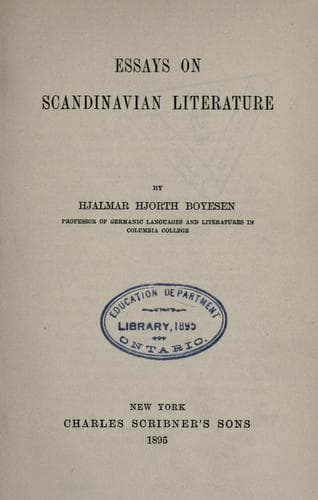
Essays on Scandinavian LiteratureBoyesen, Hjalmar Hjorth
History
Essays on Scandinavian Literature
Boyesen, Hjalmar Hjorth
Authors, Scandinavian; Scandinavian literature -- History and criticism
It will be seen from this that Tegner was fully conscious of what he was
doing. He civilized Frithjof, because he was addressing a civilized
audience which would have taken little interest in the rude viking of
the eighth century, if he had been presented to them in all his savage
unrestraint. He did exactly what Tennyson did, when he made King Arthur
the model of a modern English gentleman and (by implication) a
Protestant a thousand years before Protestantism existed. Ingeborg, too,
had to be a trifle modified and disembarrassed of a few somewhat too
naturalistic traits with which the saga endows her, before she became
the lovely type that she is of the faithful, loving, long-suffering,
womanhood of the North, with trustful blue eyes, golden hair, and a
heart full of sweet and beautiful sentiment. It was because
Oehlenschlaeger had neglected to make sufficient concessions to modern
demands that his "Helge" (though in some respects a greater poem than
"Frithjof's Saga") never crossed the boundary of Scandinavia, and even
there made no deep impression upon the general public.
Though the story of "Frithjof" is familiar to most readers, I may be
pardoned for presenting a brief _resume_. The general plot, in Tegner's
version, coincides in its main outlines with that of the saga. Frithjof,
the son of the free yeoman Thorstein Vikingson, is fostered in the house
of the peasant Hilding, with Ingeborg, the daughter of King Bele of
Sogn. The King and the yeoman have been life-long friends, and each has
a most cordial regard for the other.
"By sword upheld, King Bele in King's-hall stood,
Beside him Thorstein Vikingson, that yeoman good,
His battle-friend with almost a century hoary,
And deep-marked like a rune-stone with scars of glory."
The yeoman's son and the king's daughter, thrown into daily
companionship in their foster-father's hall, love each other; and
Frithjof, after the death of their fathers, goes to Ingeborg's brothers,
Helge and Halfdan, and asks her hand in marriage. His suit is scornfully
rejected, and he departs in wrath vowing vengeance. The ancient King
Ring, of Ringerike, having heard of Ingeborg's beauty, sends also
ambassadors to woo her. Her brothers make sacrifices in order to
ascertain the will of the gods. The omens are inauspicious, and they
accordingly feel compelled to decline the King's offer.
Public-domain text, read in full here on John Shaqi.
Reviews
Reviews
No reviews yet
Be the first to share your thoughts on this work.
Elsewhere in the archive
Join the Discussion
Join the discussion
Sign in to leave a comment or review.
Sign InorCreate an account