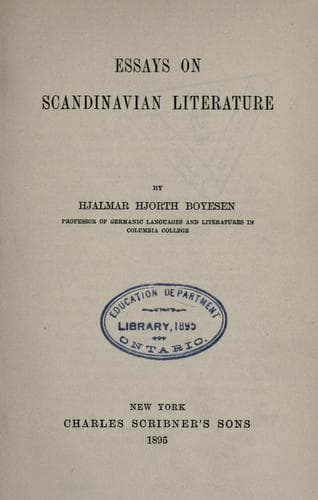
Essays on Scandinavian LiteratureBoyesen, Hjalmar Hjorth
History
Essays on Scandinavian Literature
Boyesen, Hjalmar Hjorth
Authors, Scandinavian; Scandinavian literature -- History and criticism
The old Norse viking is made to anticipate sentiments which
are of far later growth; but for all that the verses are quite stirring:
"Brow of creation,
Thou North sublime!
I have no station
Within thy clime.
Proud, hence descended
My race I tell;
Of heroes splendid,
Fond nurse, farewell!
* * * * *
My love false-hearted,
My manor burned,
My name departed,
An outlaw, spurned,
I now appealing
From earth, will dwell
With waves, for healing.
Farewell, farewell!"[39]
[39] Sherman's translation.
Frithjof now roams for many years over the sea as a viking, and gains
much booty and honor. His viking code, with its swift anapestic rhythm,
has a breezy melody which sings in the ear. It is an attempt to embody
the ethics of Norse warfare at its best, and to present in the most
poetic light the rampant, untamable individualism of the ancient
Germanic paganism. In defiance of his friend Bjoern's advice, Frithjof,
weary of this bootless chase for glory and pelf, resolves to see
Ingeborg once more before he dies, and, disguised as a salt-boiler, he
enters King Ring's hall. There he sees his beloved sitting in the
high-seat beside her aged lord; and the sorrow which the years had
dulled revives with an exquisite agony. He punishes with fierce
promptitude one of the King's men who insults him; and his answer to the
King's rebuke betrays him as a man of rank and station. He then throws
away his disguise, without, however, revealing his name, but Ingeborg
instantly recognizes him.
"Then even to her temples the queen's deep blushes sped,
As when the northlight tinges the snow-clad fields with red,
And like two full-blown lilies on racking waves which rest,
With ill-concealed emotion so heaved her throbbing breast."
The king now invites the stranger, who calls himself Thjof, to remain
his guest during the winter, and Frithjof accepts. He makes, however, no
approach to Ingeborg, with whom he scarcely exchanges a single word.
During a sleigh-ride on the ice he saves, by a tremendous feat of
strength, the life of the king and queen. With the coming of the spring
preparations are made for a grand chase, in which Frithjof participates.
"Spring is coming, birds are twittering, forests leaf, and smiles
the sun;
And the loosened torrents downward singing to the ocean run;
Glowing like the cheek of Freya, peeping rosebuds 'gin to ope,
And in human hearts awaken love of life and joy and hope."
The canto called "The Temptation" contains the most dramatic and
altogether the most beautiful situation in the poem. The old king,
feigning weariness, begs Frithjof to tarry with him alone, while he
takes a rest. Frithjof tries to dissuade him, but in vain.
Public-domain text, read in full here on John Shaqi.
Reviews
Reviews
No reviews yet
Be the first to share your thoughts on this work.
Elsewhere in the archive
Join the Discussion
Join the discussion
Sign in to leave a comment or review.
Sign InorCreate an account