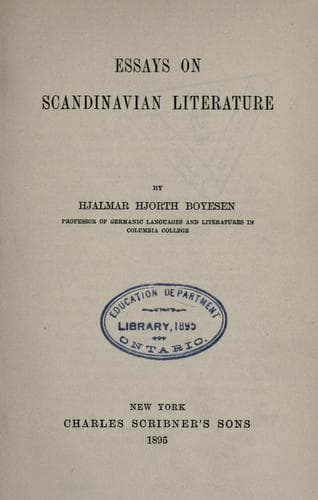
Essays on Scandinavian LiteratureBoyesen, Hjalmar Hjorth
History
Essays on Scandinavian Literature
Boyesen, Hjalmar Hjorth
Authors, Scandinavian; Scandinavian literature -- History and criticism
"Then threw Frithjof down his mantle, and upon the green sward
spread;
And the ancient king, so trustful, laid on Frithjof's knee his head;
Slept as calmly as the hero sleepeth after war's alarms
On his shield, calm as an infant slumbers in its mother's arms."
Then the temptation comes to Frithjof to slay the old man who had stolen
his bride; but after a brief struggle he hurls his sword far away into
the forest.
"Straight the ancient king awakens. 'Sweet has been my sleep,' he
said.
'Pleasant 'tis to sleep in shadow, guarded by a brave man's blade.
But where is thy sword, O stranger, lightning's brother, where is
he?
Who has parted one from other that should never parted be?'"
"'Not a whit care I,' said Frithjof, 'I shall find a sword some day;
Sharp, O King, are tongues of falchions, words of peace they seldom
say;
In the steel dwell swarthy demons, demons strayed from Nifelhem,
No man's sleep to them is sacred, silver locks embitter them.'
"'Youth, no moment have I slumbered, but to prove thee feigned to
rest,
Unproved men and weapons never trusts King Ring without a test.
Thou art Frithjof. I have known thee since thou first cam'st to my
hall;
Much that thou hast hidden from me; from the first I guessed it
all.'"
Soon after this interview the aged king feels death approaching; and in
order not to go to the dark abode of Hela, he cuts death-runes upon his
breast and ascends to Odin's bright hall. But before dying he gives
Ingeborg to Frithjof, and makes him the guardian of his son. The people,
in _Thing_ assembled, glorying in Frithjof's great renown, desire,
however, to make him King's successor; but he lifts the small boy above
his head upon his shield and proclaims him king. He returns home and
rebuilds Balder's temple, whereupon the sentence of outlawry is removed,
and he is reconciled to Ingeborg's brothers and marries the beloved of
his youth.
The last canto, called "The Atonement," is perhaps the most flagrant
violation of historical verisimilitude in the whole epic. A hoary priest
of Balder actually performs the wedding ceremony in the restored temple,
and pronounces a somewhat unctuous wedding oration, which differs from
those which Tegner himself had frequently delivered chiefly in the
substitution of pagan for the Christian deities. As a matter of fact,
marriage was a purely civil contract among the ancient Norsemen, and had
no association with the temple or the priesthood, which, by the way, was
no separate office but a patriarchal function belonging to the secular
chieftainship. But Tegner's public were in nowise shocked by
anachronisms of this sort; they probably rejoiced the more heartily in
the happiness of the reunited lovers, because their marriage was,
according to modern notions, so "regular."
Public-domain text, read in full here on John Shaqi.
Reviews
Reviews
No reviews yet
Be the first to share your thoughts on this work.
Elsewhere in the archive
Join the Discussion
Join the discussion
Sign in to leave a comment or review.
Sign InorCreate an account