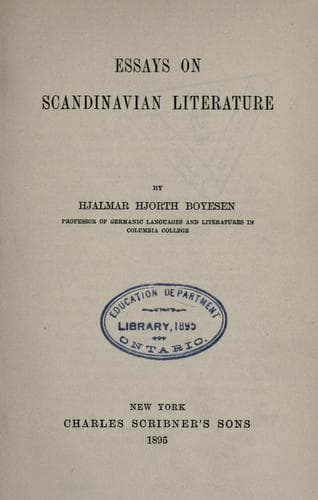
Essays on Scandinavian LiteratureBoyesen, Hjalmar Hjorth
History
Essays on Scandinavian Literature
Boyesen, Hjalmar Hjorth
Authors, Scandinavian; Scandinavian literature -- History and criticism
This passage is by no means the only one in which Tegner, with an utter
absence of vanity or illusion, judged his work and found it wanting.
There is no mock modesty in his manly deprecation of the honors that
were showered upon him; but as a father knows best the faults of his
child whom he loves, so he knew the defects of his work, as measured by
his own high standard, and refused to accept any more praise than was
his due. Not even the fact that Goethe expressed his admiration of
"Frithjof's Saga" could persuade him that he was entitled to the
extravagant homage which his enthusiastic countrymen accorded him. There
were even times when he disclaimed the title of poet. Whether he was
forgotten a little sooner or a little later, he said, was a matter of
small moment.
"Speaking seriously," he writes in 1824 (accordingly before the
publication of "Frithjof"), "I have never regarded myself as a poet in
the higher significance of the word.... I am at best a John the Baptist,
who is preparing the way for him who is to come."
He is always just and inclined to be generous in his judgment of every
one except himself. It is necessary, however, after the year 1824, to
make due allowance for the terrible strain upon his mind which disposed
him to give violent and hyperbolical expression to the mood of the
moment. The unhappy passion which he could at times smother, but never
subdue, went boring away into his heart like a subterranean fire,
consuming his vitals, and occasionally breaking forth into a wild blaze.
The following reference to it, in his letter to Franzen (November 13,
1825), is very pathetic:
"It is to-day my forty-third birthday. I have thus long since
passed the highest altitude of life where the waters divide. With
every year one now becomes smaller and smaller; one star is
extinguished after another. And yet the sun does not rise. One dies
by degrees and by halves. Therefore only children and youth ought
to celebrate their birthdays with joy; we who have passed into the
valley of age, which with every step is growing darker and
chillier, are right in celebrating them with--whims.... However,
this is not my only or my greatest affliction, I have had and have
others. But the night is silent and the grave is dumb, and their
sister, Sorrow, should be as they. Therefore--let this suffice."
Public-domain text, read in full here on John Shaqi.
Reviews
Reviews
No reviews yet
Be the first to share your thoughts on this work.
Elsewhere in the archive
Join the Discussion
Join the discussion
Sign in to leave a comment or review.
Sign InorCreate an account