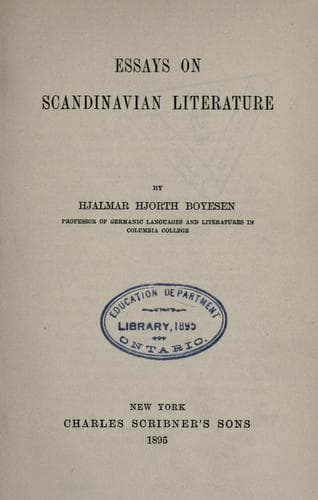
Essays on Scandinavian LiteratureBoyesen, Hjalmar Hjorth
History
Essays on Scandinavian Literature
Boyesen, Hjalmar Hjorth
Authors, Scandinavian; Scandinavian literature -- History and criticism
It was soon after his publication of "Frithjof's Saga" that Tegner
became Bishop of Wexioe. He then removed from Lund and took up his
residence upon the estate Oestrabo, near the principal town in his
diocese. The great fame of his poem came to him as a surprise; and he
even undertook to protest against it, declaring with perfect sincerity
that he held it to be undeserved. In letters to his friends he never
wearied of pointing out the faults of "Frithjof" and his own
shortcomings as a poet. In a letter to the poet Leopold (August 17,
1825), who had praised the poem to the skies, he argues seriously to
prove that his admiration is misplaced:
"My great fault in 'Frithjof' was not that I chose my theme from
the old cycle of sagas, but that I treated it in a tone and with a
manner which was neither ancient nor modern, neither antiquarian
nor poetical, but hovered, as it were, on the boundary of both. For
what does it mean to treat a subject poetically if not this, to
eliminate everything which belongs to an alien and past age and now
no longer appeals to any heart? The hearts to which it once did
appeal are now all dust. Other modes of thought and feeling are
current. It is impossible to properly translate one age into
another. But to poetry nothing is really past. Poetry is the
beautifying life of the moment; she wears the colors of the day;
she cannot conceive of anything as dead.... But I am convinced that
all poetic treatment of a theme belonging to a past age demands its
modernization; and that everything antiquarian is here a mistake.
This holds good not only in regard to the northern tone but also in
regard to the Greek. Look, for instance, at Goethe's 'Iphigenie.'
Who does not admire the beautiful, simple, noble, Hellenic form?
And yet who has ever felt his soul warmed by this image of
stone?... No living spirit has been breathed into these nostrils;
the staring eyes gaze upon me without life and animation; no heart
beats under the Hellenically rounded marble bosom. The whole is a
mistake, infinitely more beautiful than 'Frithjof,' but fashioned
according to the game principles of art. The Greeks said that the
Muse was the daughter of Memory; but this refers only to the
material, the theme itself, which is everywhere of minor
consequence. The question, then, is as to the proper treatment.
Where it tends toward the antiquarian it misses the mark; it
represents, like 'Frithjof,' only a restored ruin."
Public-domain text, read in full here on John Shaqi.
Reviews
Reviews
No reviews yet
Be the first to share your thoughts on this work.
Elsewhere in the archive
Join the Discussion
Join the discussion
Sign in to leave a comment or review.
Sign InorCreate an account