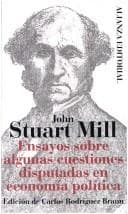
Essays on some unsettled Questions of Political EconomyMill, John Stuart
PhilosophyPhilosophy
Essays on some unsettled Questions of Political Economy
Mill, John Stuart
Economics
The equilibrium of trade would be disturbed if the imposition of the tax
diminished in the slightest degree the quantity of linen consumed. For,
as the tax is levied at our own custom-house, the German exporter only
receives the same price as formerly, though the English consumer pays a
higher one. If, therefore, there be any diminution of the quantity
bought, although a larger sum of money may be actually laid out in the
article, a smaller one will be due from England to Germany: this sum
will no longer be an equivalent for the sum due from Germany to England
for cloth, the balance therefore must be paid in money. Prices will fall
in Germany, and rise in England; linen will fall in the German market;
cloth will rise in the English. The Germans will pay higher price for
cloth, and will have smaller money incomes to buy it with; while the
English will obtain linen cheaper, that is, its price will exceed what
it previously was by less than the amount of the duty, while their means
of purchasing it will be increased by the increase of their money
incomes.
If the imposition of the tax does not diminish the demand, it will leave
the trade exactly as it was before. We shall import as much, and export
as much; the whole of the tax will be paid out of our own pockets.
But the imposition of a tax on a commodity, almost always diminishes the
demand more or less; and it can never, or scarcely ever increase the
demand. It may, therefore, be laid down as a principle, that a tax on
imported commodities, when it really operates as a tax, and not as a
prohibition, either total or partial, almost always falls in part upon
the foreigners who consume our goods: and that this is a mode in which a
nation may be almost sure of appropriating to itself, at the expense of
foreigners, a larger share than would otherwise belong to it of the
increase in the general productiveness of the labour and capital of the
world, which results from the interchange of commodities among nations.
It is scarcely necessary to observe, that no such advantage can result
from the duty, if it operate as a protecting duty; if it induce the
country which imposes it, to produce for herself that which she would
otherwise have imported. The saving of labour--the increase in the
general productiveness of the capital of the world--which is the effect
of commerce, and which a non-protecting duty would enable the country
imposing it to engross, could not be engrossed by a protecting duty,
because such a duty prevents any such increased production from
existing.
With a view to practical legislation, therefore, duties on importation
may be divided into two classes: those which have the effect of
encouraging some particular branch of domestic industry, and those which
have not.
Public-domain text, read in full here on John Shaqi.
Reviews
Reviews
No reviews yet
Be the first to share your thoughts on this work.
Join the Discussion
Join the discussion
Sign in to leave a comment or review.
Sign InorCreate an account