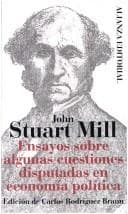
Essays on some unsettled Questions of Political EconomyMill, John Stuart
PhilosophyPhilosophy
Essays on some unsettled Questions of Political Economy
Mill, John Stuart
Economics
There would be no advantage, therefore, in imposing duties of this kind,
with a view to gain by them, in the manner which has been pointed out.
But so long as any other kind of taxes on commodities are retained, as a
source of revenue, these may often be as unobjectionable as the rest. It
is evident, moreover, that considerations of reciprocity, which are
quite unessential when the matter in debate is a protecting duty, are of
material importance when the repeal of duties of this other description
is discussed. A country cannot be expected to renounce the power of
taxing foreigners, unless foreigners will in return practise towards
itself the same forbearance. The only mode in which a country can save
itself from being a loser by the duties imposed by other countries on
its commodities, is to impose corresponding duties on theirs. Only it
must take care that these duties be not so high as to exceed all that
remains of the advantage of the trade, and put an end to importation
altogether; causing the article to be either produced at home, or
imported from another and a dearer market.
It is not necessary to apply the principles which we have stated to the
case of bounties on exportation or importation. The application is easy,
and the conclusions present nothing of particular interest or
importance.
6. Any cause which alters the exports or imports from one country into
another, alters the division of the advantage of interchange between
those two countries. Suppose the discovery of a new process, by which
some article of export, or some article not previously exported, can be
produced so cheap as to occasion a great demand for it in other
countries. This of course produces a great influx of money from other
countries, and lowers the prices of all articles imported from them,
until the increase of importation produced by this cause has restored
the equilibrium. Thus, the country which acquires a new article of
export gets its imports cheaper. This is not a case of mere alteration
in the division of the advantage; it is a new advantage created by the
discovery.
But suppose that the invention, to which the nation is indebted for this
increase of the return to its industry, comes into use also in the other
country, and that the process is one which can be as perfectly and as
cheaply performed in the one country as in the other. The new
exportation will cease; trade will revert to its old channels, the money
which flowed in will again flow out, and the country which invented the
process will lose that increase of its gain by trade, which it had
derived from the discovery.
Now the exportation of machinery comes within the case which we have
just described.
Public-domain text, read in full here on John Shaqi.
Reviews
Reviews
No reviews yet
Be the first to share your thoughts on this work.
Join the Discussion
Join the discussion
Sign in to leave a comment or review.
Sign InorCreate an account