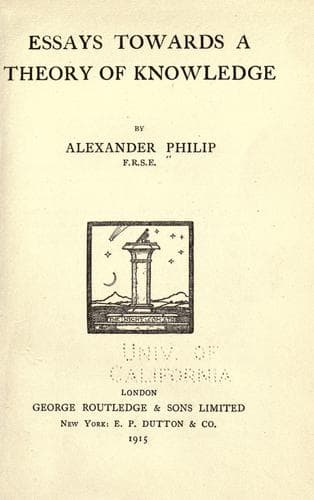
Essays Towards a Theory of KnowledgePhilip, Alexander
Philosophy
Essays Towards a Theory of Knowledge
Philip, Alexander
Cycles; Force and energy; Knowledge, Theory of
It is to the fact that all Nature is under the constraint due to the
constant silent operation of physical Force that we owe, therefore, the
law which determines the most essential features of vitality. The
pulsations in which life consists and by which it is sustained are
attributable to the constraint and limitation which we recognise as the
effect of the operation of Natural Force. It is to this same cause that
we ascribe the resistance of cohering masses in virtue of which
sensation arises and by which our experience is punctuated. It is by
means of these obstructions to free activity that our experience is
denoted, and by reference to these that it is cognised. Indeed, Activity
itself as we know it depends upon and presupposes the existence of
these cohering masses.
Thus the operation of Natural Force and the constraint and limitation
which are thereby imposed upon our activity appear at once to determine
the conditions of life and to furnish the fundamental implements of
Knowledge.
We cannot overleap the barriers by which Life is constrained. These,
whilst, on the one hand they seem to _create the environment_ which
sustains Life, on the other hand seem to impose upon it the limitations
under which it inevitably fails and dies. We cannot even in imagination
conceive, either as reality or as fancy, the illimitable puissance of a
Life perfectly free and unrestrained. Yet the assurance that Perfect
Love could overcome the bonds of Materiality and Death encourages in
mankind the Hope of an existence beyond the impenetrable veil of
physical limitation. And this at any rate may be admitted, namely, that
that dynamic condition in which materiality arises is also the
condition-precedent of Tridimensionality, of Force, of Time, and of
Mutation. But we cannot thus account for the _elan vital_ itself.
FOOTNOTES:
[11:1] Plato in the dialogue _Timæus_ tells us that Time was born with
the Heavens, and that Sun, Moon, and Planets were created in order that
Time might be.
[12:1] This might be contrasted with the statement of M. Bergson who
tells us (_Evolution créatrice_, p. 11): "Plus nous approfondirons la
nature du temps plus nous comprendrons que durée signifie invention,
création de formes, elaboration continue de l'absolument nouveau."
[14:1] Recently, we believe, astronomers have favoured the view that the
day of Venus is equal in length to her year.
II
THE ORIGIN OF PHYSICAL CONCEPTS
Public-domain text, read in full here on John Shaqi.
Reviews
Reviews
No reviews yet
Be the first to share your thoughts on this work.
Join the Discussion
Join the discussion
Sign in to leave a comment or review.
Sign InorCreate an account