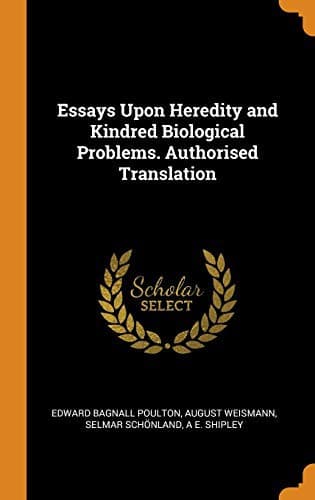
Essays Upon Heredity and Kindred Biological Problems: Authorised TranslationWeismann, August
Science
Essays Upon Heredity and Kindred Biological Problems: Authorised Translation
Weismann, August
Evolution (Biology); Genetics; Reproduction
germ-plasm, and that consequently these plants are specially adapted
for propagation by leaves. How is it then that all plants cannot be
reproduced in this way? No one has ever grown a tree from the leaf of
the lime or oak, or a flowering plant from the leaf of the tulip or
convolvulus. It is insufficient to reply that, in the last-mentioned
cases, the leaves are more strongly specialized, and have thus become
unable to produce germ-substance; for the leaf-cells in these different
plants have hardly undergone histological differentiation in different
degrees. If, notwithstanding, the one can produce a flowering plant,
while the others have not this power, it is of course clear that
reasons other than the degree of histological differentiation must
exist; and, according to my opinion, such a reason is to be found in
the admixture of a minute quantity of unchanged germ-plasm with some of
their nuclei.
In Sachs’ excellent lectures on the physiology of plants, we read on
page 723[140]—‘In the true mosses almost any cell of the roots, leaves
and shoot-axes, and even of the immature sporogonium, may grow out
under favourable conditions, become rooted, form new shoots, and give
rise to an independent living plant.’ Since such plants produce
germ-cells at a later period, we have here a case which requires the
assumption that all or nearly all cells must contain germ-plasm.
The theory of the continuity of the germ-plasm seems to me to be still
less disproved or even rendered improbable by the facts of the
alternation of generations. If the germ-plasm may pass on from the egg
into certain somatic cells of an individual, and if it can be further
transmitted along certain lines, there is no difficulty in supposing
that it may be transmitted through a second, third, or through any
number of individuals produced from the former by budding. In fact, in
the Hydroids, on which my theory of the continuity of the germ-plasm
has been chiefly based, alternation of generations is the most
important means of propagation.
II. The Significance of the Polar Bodies.
We have already seen that the specific nature of a cell depends upon
the molecular structure of its nucleus; and it follows from this
conclusion that my theory is further, and as I believe strongly,
supported, by the phenomenon of the expulsion of polar bodies, which
has remained inexplicable for so long a time.
Public-domain text, read in full here on John Shaqi.
Reviews
Reviews
No reviews yet
Be the first to share your thoughts on this work.
Elsewhere in the archive
Join the Discussion
Join the discussion
Sign in to leave a comment or review.
Sign InorCreate an account