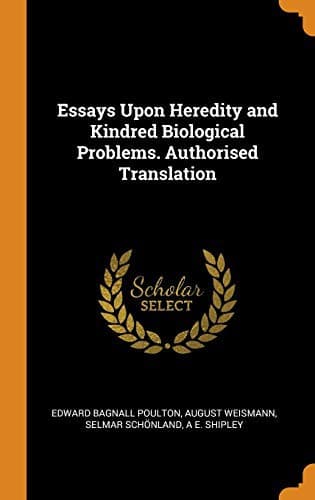
Essays Upon Heredity and Kindred Biological Problems: Authorised TranslationWeismann, August
Science
Essays Upon Heredity and Kindred Biological Problems: Authorised Translation
Weismann, August
Evolution (Biology); Genetics; Reproduction
For if the specific molecular structure of a cell-body is caused and
determined by the structure of the nucleoplasm, every kind of cell
which is histologically differentiated must have a specific
nucleoplasm. But the egg-cell of most animals, at any rate during the
period of growth, is by no means an indifferent cell of the most
primitive type. At such a period its cell-body has to perform quite
peculiar and specific functions; it has to secrete nutritive substances
of a certain chemical nature and physical constitution, and to store up
this food-material in such a manner that it may be at the disposal of
the embryo during its development. In most cases the egg-cell also
forms membranes which are often characteristic of particular species of
animals. The growing egg-cell is therefore histologically
differentiated: and in this respect resembles a somatic cell. It may
perhaps be compared to a gland-cell, which does not expel its
secretion, but deposits it within its own substance[141]. To perform
such specific functions it requires a specific cell-body, and the
latter depends upon a specific nucleus. It therefore follows that the
growing egg-cell must possess nucleoplasm of specific molecular
structure, which directs the above-mentioned secretory functions of the
cell. The nucleoplasm of histologically differentiated cells may be
called histogenetic nucleoplasm, and the growing egg-cell must contain
such a substance, and even a certain specific modification of it. This
nucleoplasm cannot possibly be the same as that which, at a later
period, causes embryonic development. Such development can only be
produced by true germ-plasm of immensely complex constitution, such as
I have previously attempted to describe. It therefore follows that the
nucleus of the egg-cell contains two kinds of nucleoplasm:—germ-plasm
and a peculiar modification of histogenetic nucleoplasm, which may be
called _ovogenetic nucleoplasm_. This substance must greatly
preponderate in the young egg-cell, for, as we have already seen, it
controls the growth of the latter. The germ-plasm, on the other hand,
can only be present in minute quantity at first, but it must undergo
considerable increase during the growth of the cell. But in order that
the germ-plasm may control the cell-body, or, in other words, in order
that embryonic development may begin, the still preponderating
ovogenetic nucleoplasm must be removed from the cell. This removal
takes place in the same manner as that in which differing nuclear
substances are separated during the ontogeny of the embryo: viz. by
nuclear division, leading to cell-division. The expulsion of the polar
bodies is nothing more than the removal of ovogenetic nucleoplasm from
the egg-cell. That the ovogenetic nucleoplasm continues to greatly
preponderate in the nucleus up to the very last, may be concluded from
the fact that two successive divisions of the latter and the expulsion
of two polar bodies appear to be the rule.
Public-domain text, read in full here on John Shaqi.
Reviews
Reviews
No reviews yet
Be the first to share your thoughts on this work.
Elsewhere in the archive
Join the Discussion
Join the discussion
Sign in to leave a comment or review.
Sign InorCreate an account