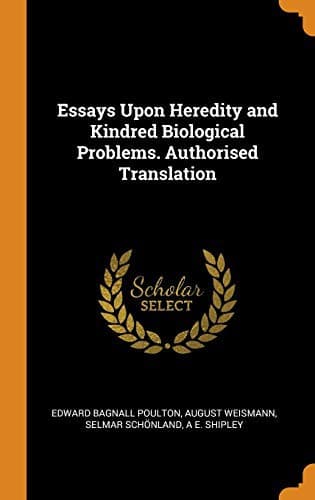
Essays Upon Heredity and Kindred Biological Problems: Authorised TranslationWeismann, August
Science
Essays Upon Heredity and Kindred Biological Problems: Authorised Translation
Weismann, August
Evolution (Biology); Genetics; Reproduction
The pianist, whom I have already used as an illustration, may by
practice develope the muscles of his fingers so as to ensure the
highest dexterity and power; but such an effect would be entirely
transient, for it depends upon a modification in local nutrition which
would be unable to cause any change in the molecular structure of the
germ-cells, and could not therefore produce any effect upon the
offspring. And even if we admit that some change might be caused in the
germ-cells, the chances would be infinity to nothing against the
production of the appropriate effect, viz. such a change as would lead
to the development in the child of the acquired characters of the
parent.
In the lowest unicellular organisms, however, the case is entirely
different. Here parent and offspring are still, in a certain sense, one
and the same thing: the child is a part, and usually half, of the
parent. If therefore the individuals of a unicellular species are acted
upon by any of the various external influences, it is inevitable that
hereditary individual differences will arise in them; and as a matter
of fact it is indisputable that changes are thus produced in these
organisms, and that the resulting characters are transmitted. It has
been directly observed that individual differences do occur in
unicellular organisms,—differences in size, colour, form, and the
number or arrangement of cilia. It must be admitted that we have not
hitherto paid sufficient attention to this point, and moreover our best
microscopes are only very rough means of observation when we come to
deal with such minute organisms. Nevertheless we cannot doubt that the
individuals of the same species are not absolutely identical.
We are thus driven to the conclusion that the ultimate origin of
hereditary individual differences lies in the direct action of external
influences upon the organism. Hereditary variability cannot however
arise in this way at every stage of organic development, as biologists
have hitherto been inclined to believe. It can only arise in the lowest
unicellular organisms; and when once individual difference had been
attained by these, it necessarily passed over into the higher organisms
when they first appeared. Sexual reproduction coming into existence at
the same time, the hereditary differences were increased and
multiplied, and arranged in ever-changing combinations.
Public-domain text, read in full here on John Shaqi.
Reviews
Reviews
No reviews yet
Be the first to share your thoughts on this work.
Elsewhere in the archive
Join the Discussion
Join the discussion
Sign in to leave a comment or review.
Sign InorCreate an account