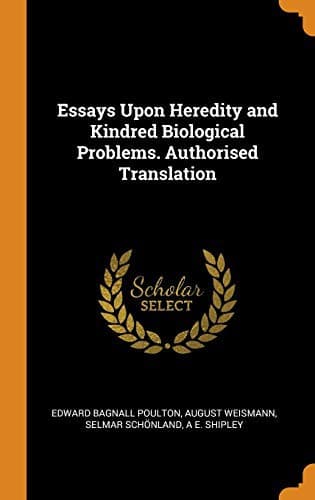
Essays Upon Heredity and Kindred Biological Problems: Authorised TranslationWeismann, August
Science
Essays Upon Heredity and Kindred Biological Problems: Authorised Translation
Weismann, August
Evolution (Biology); Genetics; Reproduction
But the fact that there is complete adaptation at
each stage does not prevent the two species from increasing those
qualities of protection and of pursuit upon which they respectively
depend. So far from this being the case, they would be necessarily
compelled to gradually increase these qualities so long as the physical
possibility of improvement remained on both sides. As long as some
birds possessed a rather keener sight than those which previously
existed, so long would those butterflies possess an advantage in which
the resemblance to leaf-veining was more distinct than in others. But
from the moment at which the maximum keenness of eyesight attainable
had been reached, at which therefore all butterflies resembled leaves
so completely that even the birds with the keenest eyesight might fail
to detect them when at rest,—from this very point any further
improvement in the similarity to leaves would cease, because the
advantage to be gained from any such improvement would cease at the
same time.
Such reciprocal intensification of adaptive characters appears to me to
have been one of the most important factors in the transformation of
species: it must have persisted through long series of species during
phylogeny: it must have affected the most diverse parts and characters
in the most diverse groups of organisms.
In certain large butterflies of the Indian and African forests—_Kallima
paralecta_, _K. inachis_, and _K. albofasciata_—it has been frequently
pointed out that the deceptive resemblance to a leaf is so striking
that an observer who has received no hint upon the subject believes
that he sees a leaf, even when he is looking at the butterfly very
closely. The similarity is nevertheless incomplete; for out of sixteen
specimens in the collections at Amsterdam and Leyden, I could not find
a single one which had more than two lateral veins on one side of the
mid-rib of the supposed leaf, or more than three upon the other side;
while about six or seven veins should have been present on each side.
But from two to three lateral veins are amply sufficient to produce a
high degree of resemblance; in fact so much so that it is a matter for
wonder as to how it has been possible for such a relatively perfect
copy to have been produced; or how the sight of birds can have become
so highly developed that while flying rapidly they could perceive the
vein-like markings; or to state the case more accurately, that they
could detect those individuals with a less number of veins than others.
It is possible that the process of increase in resemblance is still
proceeding in the species of the genus _Kallima_; at all events, I was
struck by the rather strong individual differences in the markings of
the supposed leaf.
Public-domain text, read in full here on John Shaqi.
Reviews
Reviews
No reviews yet
Be the first to share your thoughts on this work.
Elsewhere in the archive
Join the Discussion
Join the discussion
Sign in to leave a comment or review.
Sign InorCreate an account