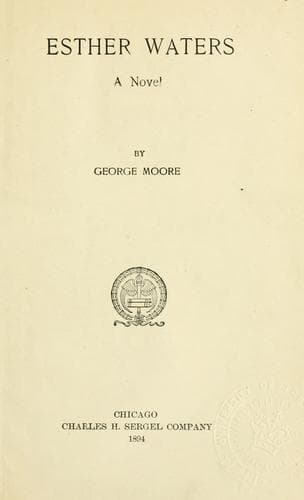
Domestic fiction; England -- Fiction; Mothers and sons -- Fiction; Unmarried mothers -- Fiction; Women household employees -- Fiction
Her baby grew heavy in her arms, and the vagrant, a bundle of rags thrown
forward in a heap, slept at the other end of the bench. But she could not
sleep, and the moon whirled on her miserable way. Then the glassy
stillness was broken by the measured tramp of the policeman going his
rounds. He directed her to Lambeth Workhouse, and as she walked towards
Westminster she heard him rousing the vagrant and bidding him move onward.
XX
Those who came to the workhouse for servants never offered more than
fourteen pounds a year, and these wages would not pay for her baby's keep
out at nurse. Her friend the matron did all she could, but it was always
fourteen pounds. "We cannot afford more." At last an offer of sixteen
pounds a year came from a tradesman in Chelsea; and the matron introduced
Esther to Mrs. Lewis, a lonely widowed woman, who for five shillings a
week would undertake to look after the child. This would leave Esther
three pounds a year for dress; three pounds a year for herself.
What luck!
The shop was advantageously placed at a street corner. Twelve feet of
fronting on the King's Road, and more than half that amount on the side
street, exposed to every view wall papers and stained glass designs. The
dwelling-house was over the shop; the shop entrance faced the kerb in the
King's Road.
The Bingleys were Dissenters. They were ugly, and exacted the uttermost
farthing from their customers and their workpeople. Mrs. Bingley was a
tall, gaunt woman, with little grey ringlets on either side of her face.
She spoke in a sour, resolute voice, when she came down in a wrapper to
superintend the cooking. On Sundays she wore a black satin, fastened with
a cameo brooch, and round her neck a long gold chain. Then her manners
were lofty, and when her husband called "Mother," she answered testily,
"Don't keep on mothering me." She frequently stopped him to settle his
necktie or collar. All the week he wore the same short jacket; on Sundays
he appeared in an ill-fitting frock-coat. His long upper lip was clean
shaven, but under his chin there grew a ring of discoloured hair, neither
brown nor red, but the neutral tint that hair which does not turn grey
acquires. When he spoke he opened his mouth wide, and seemed quite
unashamed of the empty spaces and the three or four yellow fangs that
remained.
John, the elder of the two brothers, was a silent youth whose one passion
seemed to be eavesdropping. He hung round doors in the hopes of
overhearing his sisters' conversation and if he heard Esther and the
little girl who helped Esther in her work talking in the kitchen, he would
steal cautiously halfway down the stairs. Esther often thought that his
young woman must be sadly in want of a sweetheart to take on with one such
as he. "Come along, Amy," he would cry, passing out before her; and not
even at the end of a long walk did he offer her his arm; and they came
strolling home just like boy and girl.
Public-domain text, read in full here on John Shaqi.
Reviews
Reviews
No reviews yet
Be the first to share your thoughts on this work.
Elsewhere in the archive
Join the Discussion
Join the discussion
Sign in to leave a comment or review.
Sign InorCreate an account