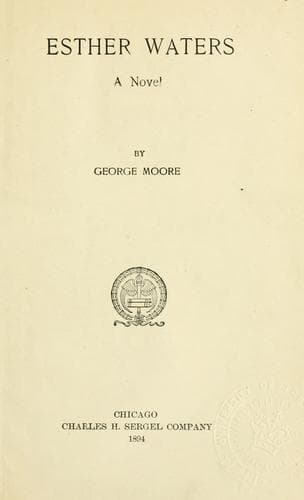
Domestic fiction; England -- Fiction; Mothers and sons -- Fiction; Unmarried mothers -- Fiction; Women household employees -- Fiction
But although Saunders spent a great deal of his money in the public-house,
he rarely got drunk and always kept his employment. He was a painter of
engines, a first-rate hand, earning good money, from twenty-five to thirty
shillings a week. He was a proud man, but so avaricious that he stopped at
nothing to get money. He was an ardent politician, yet he would sell his
vote to the highest bidder, and when Esther was seventeen he compelled her
to take service regardless of the character of the people or of what the
place was like. They had left Barnstaple many months, and were now living
in a little street off the Vauxhall Bridge Road, near the factory where
Saunders worked; and since they had been in London Esther had been
constantly in service. Why should he keep her? She wasn't one of his
children, he had quite enough of his own. Sometimes of an evening, when
Esther could escape from her drudgery for a few minutes, her mother would
step round, and mother and daughter, wrapped in the same shawl, would walk
to and fro telling each other their troubles, just as in old times. But
these moments were few. In grimy lodging-houses she worked from early
morning till late at night, scrubbing grates, preparing bacon and eggs,
cooking chops, and making beds. She had become one of those London girls
to whom rest, not to say pleasure, is unknown, who if they should sit down
for a few moments hear the mistress's voice, "Now, Eliza, have you nothing
to do, that you are sitting there idle?" Two of her mistresses, one after
the other, had been sold up, and now all the rooms in the neighbourhood
were unlet, no one wanted a "slavey," and Esther was obliged to return
home. It was on the last of these occasions that her father had taken her
by the shoulders, saying----
"No lodging-houses that want a slavey? I'll see about that. Tell me,
first, have you been to 78?"
"Yes, but another girl was before me, and the place was taken when I
arrived."
"I wonder what you were doing that you didn't get there sooner; dangling
about after your mother, I suppose! Well, what about 27 in the Crescent?"
"I couldn't go there--that Mrs. Dunbar is a bad woman."
"Bad woman! Who are you, I should like to know, that you can take a lady's
character away? Who told you she was a bad woman? One of the
Scripture-readers, I suppose! I knew it was. Well, then, just get out of
my house."
"Where shall I go?"
"Go to hell for all I care. Do you hear me? Get out!"
Esther did not move--words, and then blows. Esther's escape from her
stepfather seemed a miracle, and his anger was only appeased by Mrs.
Saunders promising that Esther should accept the situation.
"Only for a little while. Perhaps Mrs. Dunbar is a better woman than you
think for. For my sake, dearie. If you don't he may kill you and me too."
Esther looked at her one moment, then she said, "Very well, mother,
to-morrow I'll take the place."
Public-domain text, read in full here on John Shaqi.
Reviews
Reviews
No reviews yet
Be the first to share your thoughts on this work.
Join the Discussion
Join the discussion
Sign in to leave a comment or review.
Sign InorCreate an account