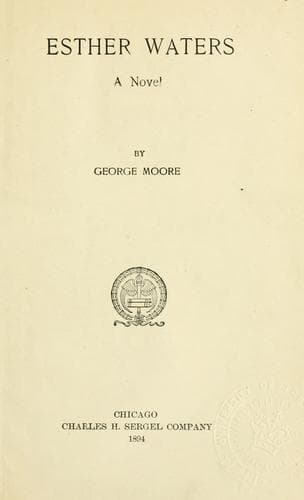
Domestic fiction; England -- Fiction; Mothers and sons -- Fiction; Unmarried mothers -- Fiction; Women household employees -- Fiction
Esther looked, and in the whitening doorways she saw the little jockey
staggering about helplessly drunk. The smile died out of her eyes; she
returned to her true self, to Mrs. Barfield and the Brethren. She felt
that all this dancing, drinking, and kissing in the arbours was wicked.
But Miss Mary had sent for her, and had told her that she would give her
one of her dresses, and she had not known how to refuse Miss Mary. Then,
if she had not gone, William--Sounds of loud voices were heard in the
garden, and the lean woman in the white muslin repeated some charge.
Esther ran out to see what was happening, and there she witnessed a
disgraceful scene. The lean woman in the muslin dress and the amber beads
accused young Mr. Preston of something which he denied, and she heard
William tell someone that he was mistaken, that he and his pals didn't
want no rowing at this 'ere ball, and what was more they didn't mean to
have none.
And her heart filled with love for her big William. What a fine fellow he
was! how handsome were his shoulders beside that round-shouldered little
man whom he so easily pulled aside! and having crushed out the quarrel, he
helped her on with her jacket, and, hanging on his arm, they returned home
through the little town. Margaret followed with the railway porter; Sarah
was with her faithful admirer, a man with a red beard, whom she had picked
up at the ball; Grover waddled in the rear, embarrassed with the green
silk, which she held high out of the dust of the road.
When they reached the station the sky was stained with rose, and the
barren downs--more tin-like than ever in the shadow-less light of
dawn--stretched across the sunrise from Lancing to Brighton. The little
birds sat ruffling their feathers, and, awaking to the responsibilities of
the day, flew away into the corn. The night had been close and sultry, and
even at this hour there was hardly any freshness in the air. Esther looked
at the hills, examining the landscape intently. She was thinking of the
first time she saw it. Some vague association of ideas--the likeness that
the morning landscape bore to the evening landscape, or the wish to
prolong the sweetness of these, the last moments of her happiness,
impelled her to linger and to ask William if the woods and fields were not
beautiful. The too familiar landscape awoke in William neither idea nor
sensation; Esther interested him more, and while she gazed dreamily on the
hills he admired the white curve of her neck which showed beneath the
unbuttoned jacket. She never looked prettier than she did that morning,
standing on the dusty road, her white dress crumpled, the ends of the blue
sash hanging beneath the black cloth jacket.
XI
Public-domain text, read in full here on John Shaqi.
Reviews
Reviews
No reviews yet
Be the first to share your thoughts on this work.
Join the Discussion
Join the discussion
Sign in to leave a comment or review.
Sign InorCreate an account