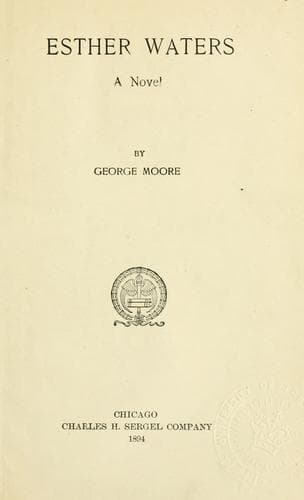
Domestic fiction; England -- Fiction; Mothers and sons -- Fiction; Unmarried mothers -- Fiction; Women household employees -- Fiction
"You can have a book of their names and addresses."
"But I know no one."
"You needn't know them. You can go and call. Take those that live
nearest--that's the way it is done."
"Then will you give me the book?"
"I'll go and get one."
The boy returned a moment after with a small book, for which he demanded a
shilling. Since she had come to London her hand had never been out of her
pocket. She had her money with her; she did not dare leave it at home on
account of her father. The clerk looked out the addresses for her and she
tried to remember them--two were in Cumberland Place, another was in
Bryanstone Square. In Cumberland Place she was received by an elderly lady
who said she did not wish to judge anyone, but it was her invariable
practice to give letters only to married women. There was a delicate smell
of perfume in the room; the lady stirred the fire and lay back in her
armchair. Once or twice Esther tried to withdraw, but the lady, although
unswervingly faithful to her principles, seemed not indifferent to
Esther's story, and asked her many questions.
"I don't see what interest all that can be to you, as you ain't going to
give me a letter," Esther answered.
The next house she called at the lady was not at home, but she was
expected back presently, and the maid servant asked her to take a seat in
the hall. But when Esther refused information about her troubles she was
called a stuck-up thing who deserved all she got, and was told there was
no use her waiting. At the next place she was received by a footman who
insisted on her communicating her business to him. Then he said he would
see if his master was in. He wasn't in; he must have just gone out. The
best time to find him was before half-past ten in the morning.
"He'll be sure to do all he can for you--he always do for the good-looking
ones. How did it all happen?"
"What business is that of yours? I don't ask your business."
"Well, you needn't turn that rusty."
At that moment the master entered. He asked Esther to come into his study.
He was a tall, youngish-looking man of three or four-and-thirty, with
bright eyes and hair, and there was in his voice and manner a kindness
that impressed Esther. She wished, however, that she had seen his mother
instead of him, for she was more than ever ashamed of her condition. He
seemed genuinely sorry for her, and regretted that he had given all his
tickets away. Then a thought struck him, and he wrote a letter to one of
his friends, a banker in Lincoln's Inn Fields. This gentleman, he said,
was a large subscriber to the hospital, and would certainly give her the
letter she required. He hoped that Esther would get through her trouble
all right.
Public-domain text, read in full here on John Shaqi.
Reviews
Reviews
No reviews yet
Be the first to share your thoughts on this work.
Elsewhere in the archive
Join the Discussion
Join the discussion
Sign in to leave a comment or review.
Sign InorCreate an account