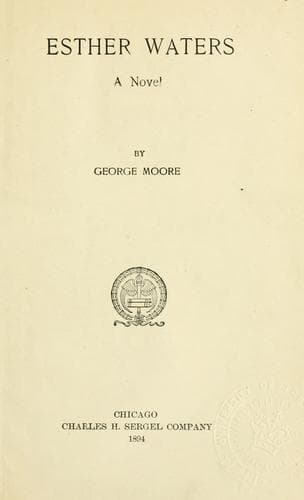
Domestic fiction; England -- Fiction; Mothers and sons -- Fiction; Unmarried mothers -- Fiction; Women household employees -- Fiction
The visit brought a little comfort into the girl's heart; and thinking of
his kind eyes she walked slowly, inquiring out her way until she got back
to the Marble Arch, and stood looking down the long Bayswater Road. The
lamps were beginning in the light, and the tall houses towered above the
sunset. Esther watched the spectral city, and some sensation of the poetry
of the hour must have stolen into her heart, for she turned into the Park,
choosing to walk there. Upon its dim green grey the scattered crowds were
like strips of black tape. Here and there by the railings the tape had
been wound up in a black ball, and the peg was some democratic orator,
promising poor human nature unconditional deliverance from evil. Further
on were heard sounds from a harmonium, and hymns were being sung, and in
each doubting face there was something of the perplexing, haunting look
which the city wore.
A chill wind was blowing. Winter had returned with the night, but the
instinct of spring continued in the branches. The deep, sweet scent of the
hyacinth floated along the railings, and the lovers that sat with their
arms about each other on every seat were of Esther's own class. She would
have liked to have called them round her and told them her miserable
story, so that they might profit by her experience.
XVI
No more than three weeks now remained between her and the dreaded day. She
had hoped to spend them with her mother, who was timorous and desponding,
and stood in need of consolation. But this was not to be; her father's
drunkenness continued, and daily he became more extortionate in his
demands for money. Esther had not six pounds left, and she felt that she
must leave. It had come to this, that she doubted if she were to stay on
that the clothes on her back might not be taken from her. Mrs. Saunders
was of the same opinion, and she urged Esther to go. But scruples
restrained her.
"I can't bring myself to leave you, mother; something tells me I should
stay with you. It is dreadful to be parted from you. I wish you was coming
to the hospital; you'd be far safer there than at home."
"I know that, dearie; but where's the good in talking about it? It only
makes it harder to bear. You know I can't leave. It is terrible hard, as
you says." Mrs. Saunders held her apron to her eyes and cried. "You have
always been a good girl, never a better--my one consolation since your
poor father died."
"Don't cry, mother," said Esther; "the Lord will watch over us, and we
shall both pray for each other. In about a month, dear, we shall be both
quite well, and you'll bless my baby, and I shall think of the time when I
shall put him into your arms."
"I hope so, Esther; I hope so, but I am full of fears. I'm sore afraid
that we shall never see one another again--leastways on this earth."
"Oh, mother, dear, yer mustn't talk like that; you'll break my heart, that
you will."
Public-domain text, read in full here on John Shaqi.
Reviews
Reviews
No reviews yet
Be the first to share your thoughts on this work.
Elsewhere in the archive
Join the Discussion
Join the discussion
Sign in to leave a comment or review.
Sign InorCreate an account