Produced by an anonymous Project Gutenberg volunteer.
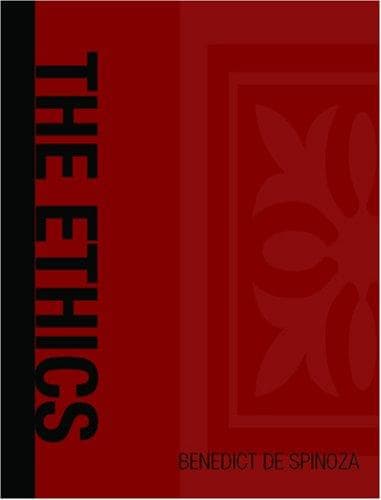
Benedict de Spinoza, THE ETHICS
(Ethica Ordine Geometrico Demonstrata)
Translated by R. H. M. Elwes
PART I: CONCERNING GOD.
DEFINITIONS.
I. By that which is 'self-caused' I mean that of which the
essence involves existence, or that of which the nature is only
conceivable as existent.
II. A thing is called 'finite after its kind' when it can be
limited by another thing of the same nature; for instance, a body
is called finite because we always conceive another greater body.
So, also, a thought is limited by another thought, but a body is
not limited by thought, nor a thought by body.
III. By 'substance' I mean that which is in itself, and is
conceived through itself: in other words, that of which a
conception can be formed independently of any other conception.
IV. By 'attribute' I mean that which the intellect perceives as
constituting the essence of substance.
V. By 'mode' I mean the modifications ("affectiones") of
substance, or that which exists in, and is conceived through,
something other than itself.
VI. By 'God' I mean a being absolutely infinite--that is, a
substance consisting in infinite attributes, of which each
expresses eternal and infinite essentiality.
>>>>>Explanation--I say absolutely infinite, not infinite after
its kind: for, of a thing infinite only after its kind, infinite
attributes may be denied; but that which is absolutely infinite,
contains in its essence whatever expresses reality, and involves
no negation.
VII. That thing is called 'free,' which exists solely by the
necessity of its own nature, and of which the action is
determined by itself alone. On the other hand, that thing is
necessary, or rather constrained, which is determined by
something external to itself to a fixed and definite method of
existence or action.
VIII. By 'eternity' I mean existence itself, in so far as it is
conceived necessarily to follow solely from the definition of
that which is eternal.
>>>>>Explanation--Existence of this kind is conceived as an
eternal truth, like the essence of a thing and, therefore,
cannot be explained by means of continuance or time, though
continuance may be conceived without a beginning or end.
AXIOMS. I. Everything which exists, exists either in itself or
in something else.
II. That which cannot be conceived through anything else must be
conceived through itself.
III. From a given definite cause an effect necessarily follows;
and, on the other hand, if no definite cause be granted, it is
impossible that an effect can follow.
IV. The knowledge of an effect depends on and involves the
knowledge of a cause.
V. Things which have nothing in common cannot be understood, the
one by means of the other; the conception of one does not involve
the conception of the other.
VI. A true idea must correspond with its ideate or object.
VII. If a thing can be conceived as non-existing, its essence
does not involve existence.
Public-domain text, read in full here on John Shaqi.
Reviews
Reviews
No reviews yet
Be the first to share your thoughts on this work.
Join the Discussion
Join the discussion
Sign in to leave a comment or review.
Sign InorCreate an account