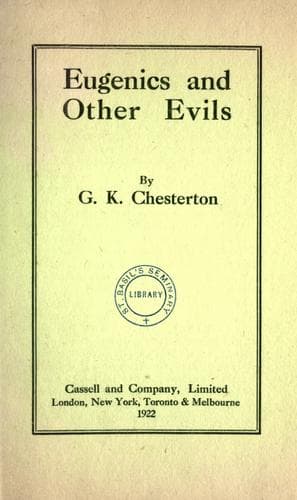
Eugenics and Other EvilsChesterton, G. K. (Gilbert Keith)
Philosophy
Eugenics and Other Evils
Chesterton, G. K. (Gilbert Keith)
Eugenics
Every tramp who is sulky, every labourer who is shy, every rustic who
is eccentric, can quite easily be brought under such conditions as
were designed for homicidal maniacs. That is the situation; and that
is the point. England has forgotten the Feudal State; it is in the
last anarchy of the Industrial State; there is much in Mr. Belloc's
theory that it is approaching the Servile State; it cannot at present
get at the Distributive State; it has almost certainly missed the
Socialist State. But we are already under the Eugenist State; and
nothing remains to us but rebellion.
CHAPTER III
THE ANARCHY FROM ABOVE
A silent anarchy is eating out our society. I must pause upon the
expression; because the true nature of anarchy is mostly
misapprehended. It is not in the least necessary that anarchy should
be violent; nor is it necessary that it should come from below. A
government may grow anarchic as much as a people. The more sentimental
sort of Tory uses the word anarchy as a mere term of abuse for
rebellion; but he misses a most important intellectual distinction.
Rebellion may be wrong and disastrous; but even when rebellion is
wrong, it is never anarchy. When it is not self-defence, it is
usurpation. It aims at setting up a new rule in place of the old rule.
And while it cannot be anarchic in essence (because it has an aim), it
certainly cannot be anarchic in method; for men must be organised when
they fight; and the discipline in a rebel army has to be as good as
the discipline in the royal army. This deep principle of distinction
must be clearly kept in mind. Take for the sake of symbolism those two
great spiritual stories which, whether we count them myths or
mysteries, have so long been the two hinges of all European morals.
The Christian who is inclined to sympathise generally with
constituted authority will think of rebellion under the image of
Satan, the rebel against God. But Satan, though a traitor, was not an
anarchist. He claimed the crown of the cosmos; and had he prevailed,
would have expected his rebel angels to give up rebelling. On the
other hand, the Christian whose sympathies are more generally with
just self-defence among the oppressed will think rather of Christ
Himself defying the High Priests and scourging the rich traders. But
whether or no Christ was (as some say) a Socialist, He most certainly
was not an Anarchist. Christ, like Satan, claimed the throne. He set
up a new authority against an old authority; but He set it up with
positive commandments and a comprehensible scheme. In this light all
mediæval people--indeed, all people until a little while ago--would
have judged questions involving revolt. John Ball would have offered
to pull down the government because it was a bad government, not
because it was a government. Richard II. would have blamed Bolingbroke
not as a disturber of the peace, but as a usurper. Anarchy, then, in
the useful sense of the word, is a thing utterly distinct from any
Public-domain text, read in full here on John Shaqi.
Reviews
Reviews
No reviews yet
Be the first to share your thoughts on this work.
Join the Discussion
Join the discussion
Sign in to leave a comment or review.
Sign InorCreate an account