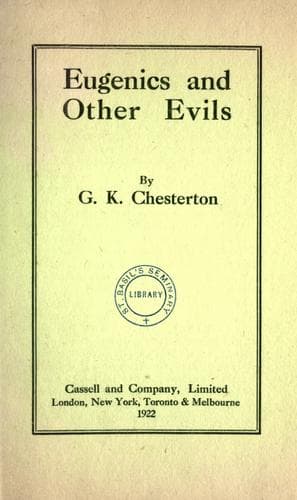
Eugenics and Other EvilsChesterton, G. K. (Gilbert Keith)
Philosophy
Eugenics and Other Evils
Chesterton, G. K. (Gilbert Keith)
Eugenics
For this reason, and for this alone, the lunatic is outside public
law. This is the abysmal difference between him and the criminal. The
criminal admits the facts, and therefore permits us to appeal to the
facts. We can so arrange the facts around him that he may really
understand that agreement is in his own interests. We can say to him,
"Do not steal apples from this tree, or we will hang you on that
tree." But if the man really thinks one tree is a lamp-post and the
other tree a Trafalgar Square fountain, we simply cannot treat with
him at all. It is obviously useless to say, "Do not steal apples from
this lamp-post, or I will hang you on that fountain." If a man denies
the facts, there is no answer but to lock him up. He cannot speak our
language: not that varying verbal language which often misses fire
even with us, but that enormous alphabet of sun and moon and green
grass and blue sky in which alone we meet, and by which alone we can
signal to each other. That unique man of genius, George Macdonald,
described in one of his weird stories two systems of space
co-incident; so that where I knew there was a piano standing in a
drawing-room you knew there was a rose-bush growing in a garden.
Something of this sort is in small or great affairs the matter with
the madman. He cannot have a vote, because he is the citizen of
another country. He is a foreigner. Nay, he is an invader and an
enemy; for the city he lives in has been super-imposed on ours.
Now these two things are primarily to be noted in his case. First,
that we can only condemn him to a _general_ doom, because we only know
his _general_ nature. All criminals, who do particular things for
particular reasons (things and reasons which, however criminal, are
always comprehensible), have been more and more tried for such
separate actions under separate and suitable laws ever since Europe
began to become a civilisation--and until the rare and recent
re-incursions of barbarism in such things as the Indeterminate
Sentence. Of that I shall speak later; it is enough for this argument
to point out the plain facts. It is the plain fact that every savage,
every sultan, every outlawed baron, every brigand-chief has always
used this instrument of the Indeterminate Sentence, which has been
recently offered us as something highly scientific and humane. All
these people, in short, being barbarians, have always kept their
captives captive until they (the barbarians) chose to think the
captives were in a fit frame of mind to come out. It is also the plain
fact that all that has been called civilisation or progress, justice
or liberty, for nearly three thousand years, has had the general
direction of treating even the captive as a free man, in so far as
some clear case of some defined crime had to be shown against him.
All law has meant allowing the criminal, within some limits or other,
to argue with the law: as Job was allowed, or rather challenged, to
argue with God.
Public-domain text, read in full here on John Shaqi.
Reviews
Reviews
No reviews yet
Be the first to share your thoughts on this work.
Join the Discussion
Join the discussion
Sign in to leave a comment or review.
Sign InorCreate an account