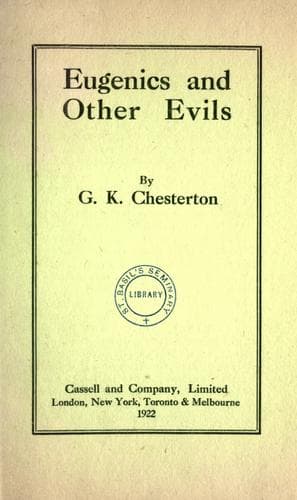
Eugenics and Other EvilsChesterton, G. K. (Gilbert Keith)
Philosophy
Eugenics and Other Evils
Chesterton, G. K. (Gilbert Keith)
Eugenics
I confine myself here to remarking that I do not like it. I may be
very stingy, but I am willing to pay the scientist for what he does
know; I draw the line at paying him for everything he doesn't know. I
may be very cowardly, but I am willing to be hurt for what I think or
what he thinks--I am not willing to be hurt, or even inconvenienced,
for whatever he might happen to think after he had hurt me. The
ordinary citizen may easily be more magnanimous than I, and take the
whole thing on trust; in which case his career may be happier in the
next world, but (I think) sadder in this. At least, I wish to point
out to him that he will not be giving his glorious body as soldiers
give it, to the glory of a fixed flag, or martyrs to the glory of a
deathless God. He will be, in the strict sense of the Latin phrase,
giving his vile body for an experiment--an experiment of which even
the experimentalist knows neither the significance nor the end.
CHAPTER VIII
A SUMMARY OF A FALSE THEORY
I have up to this point treated the Eugenists, I hope, as seriously as
they treat themselves. I have attempted an analysis of their theory as
if it were an utterly abstract and disinterested theory; and so
considered, there seems to be very little left of it. But before I go
on, in the second part of this book, to talk of the ugly things that
really are left, I wish to recapitulate the essential points in their
essential order, lest any personal irrelevance or over-emphasis (to
which I know myself to be prone) should have confused the course of
what I believe to be a perfectly fair and consistent argument. To make
it yet clearer, I will summarise the thing under chapters, and in
quite short paragraphs.
In the first chapter I attempted to define the essential point in
which Eugenics can claim, and does claim, to be a new morality. That
point is that it is possible to consider the baby in considering the
bride. I do not adopt the ideal irresponsibility of the man who said,
"What has posterity done for us?" But I do say, to start with, "What
can we do for posterity, except deal fairly with our contemporaries?"
Unless a man love his wife whom he has seen, how shall he love his
child whom he has not seen?
In the second chapter I point out that this division in the conscience
cannot be met by mere mental confusions, which would make any woman
refusing any man a Eugenist. There will always be something in the
world which tends to keep outrageous unions exceptional; that
influence is not Eugenics, but laughter.
Public-domain text, read in full here on John Shaqi.
Reviews
Reviews
No reviews yet
Be the first to share your thoughts on this work.
Join the Discussion
Join the discussion
Sign in to leave a comment or review.
Sign InorCreate an account