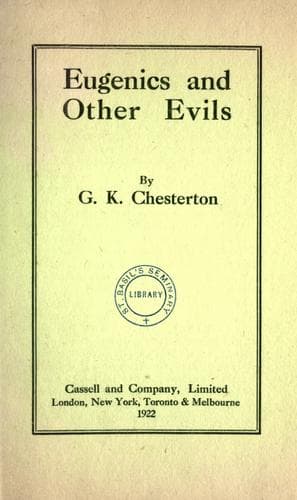
Eugenics and Other EvilsChesterton, G. K. (Gilbert Keith)
Philosophy
Eugenics and Other Evils
Chesterton, G. K. (Gilbert Keith)
Eugenics
children, if he did all the duties of his station, one of which might
be helping his wife off her horse; but he would not have refrained
from doing this because he had read in a book that a course of falling
off horses often resulted in the birth of a genius. Both Moslem and
Christian would have thought such speculations not only impious but
utterly unpractical. I quite agree with them; but that is not the
point here.
The point here is that a new school believes Eugenics _against_
Ethics. And it is proved by one familiar fact: that the heroisms of
history are actually the crimes of Eugenics. The Eugenists' books and
articles are full of suggestions that non-eugenic unions should and
may come to be regarded as we regard sins; that we should really feel
that marrying an invalid is a kind of cruelty to children. But history
is full of the praises of people who have held sacred such ties to
invalids; of cases like those of Colonel Hutchinson and Sir William
Temple, who remained faithful to betrothals when beauty and health had
been apparently blasted. And though the illnesses of Dorothy Osborne
and Mrs. Hutchinson may not fall under the Eugenic speculations (I do
not know), it is obvious that they might have done so; and certainly
it would not have made any difference to men's moral opinion of the
act. I do not discuss here which morality I favour; but I insist that
they are opposite. The Eugenist really sets up as saints the very men
whom hundreds of families have called sneaks. To be consistent, they
ought to put up statues to the men who deserted their loves because of
bodily misfortune; with inscriptions celebrating the good Eugenist
who, on his fiancée falling off a bicycle, nobly refused to marry her;
or to the young hero who, on hearing of an uncle with erysipelas,
magnanimously broke his word. What is perfectly plain is this: that
mankind have hitherto held the bond between man and woman so sacred,
and the effect of it on the children so incalculable, that they have
always admired the maintenance of honour more than the maintenance of
safety. Doubtless they thought that even the children might be none
the worse for not being the children of cowards and shirkers; but this
was not the first thought, the first commandment. Briefly, we may say
that while many moral systems have set restraints on sex almost as
severe as any Eugenist could set, they have almost always had the
character of securing the fidelity of the two sexes to each other, and
leaving the rest to God. To introduce an ethic which makes that
fidelity or infidelity vary with some calculation about heredity is
that rarest of all things, a revolution that has not happened before.
Public-domain text, read in full here on John Shaqi.
Reviews
Reviews
No reviews yet
Be the first to share your thoughts on this work.
Join the Discussion
Join the discussion
Sign in to leave a comment or review.
Sign InorCreate an account