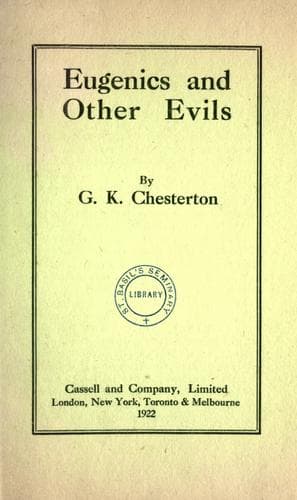
Eugenics and Other EvilsChesterton, G. K. (Gilbert Keith)
Philosophy
Eugenics and Other Evils
Chesterton, G. K. (Gilbert Keith)
Eugenics
Now the trouble of the nineteenth century very largely came from the
loss of this; the loss of what we may call the natural and heathen
mysticism. When modern critics say that Julius Caesar did not believe
in Jupiter, or that Pope Leo did not believe in Catholicism, they
overlook an essential difference between those ages and ours. Perhaps
Julius did not believe in Jupiter; but he did not disbelieve in
Jupiter. There was nothing in his philosophy, or the philosophy of
that age, that could forbid him to think that there was a spirit
personal and predominant in the world. But the modern materialists are
not permitted to doubt; they are forbidden to believe. Hence, while
the heathen might avail himself of accidental omens, queer
coincidences or casual dreams, without knowing for certain whether
they were really hints from heaven or premonitory movements in his own
brain, the modern Christian turned heathen must not entertain such
notions at all, but must reject the oracle as the altar. The modern
sceptic was drugged against all that was natural in the supernatural.
And this was why the modern tyrant marched upon his doom, as a tyrant
literally pagan might possibly not have done.
There is one idea of this kind that runs through most popular tales
(those, for instance, on which Shakespeare is so often based)--an idea
that is profoundly moral even if the tales are immoral. It is what
may be called the flaw in the deed: the idea that, if I take my
advantage to the full, I shall hear of something to my disadvantage.
Thus Midas fell into a fallacy about the currency; and soon had reason
to become something more than a Bimetallist. Thus Macbeth had a
fallacy about forestry; he could not see the trees for the wood. He
forgot that, though a place cannot be moved, the trees that grow on it
can. Thus Shylock had a fallacy of physiology; he forgot that, if you
break into the house of life, you find it a bloody house in the most
emphatic sense. But the modern capitalist did not read fairy-tales,
and never looked for the little omens at the turnings of the road. He
(or the most intelligent section of him) had by now realised his
position, and knew in his heart it was a false position. He thought a
margin of men out of work was good for his business; he could no
longer really think it was good for his country. He could no longer be
the old "hard-headed" man who simply did not understand things; he
could only be the hard-hearted man who faced them. But he still
marched on; he was sure he had made no mistake.
Public-domain text, read in full here on John Shaqi.
Reviews
Reviews
No reviews yet
Be the first to share your thoughts on this work.
Elsewhere in the archive
Join the Discussion
Join the discussion
Sign in to leave a comment or review.
Sign InorCreate an account