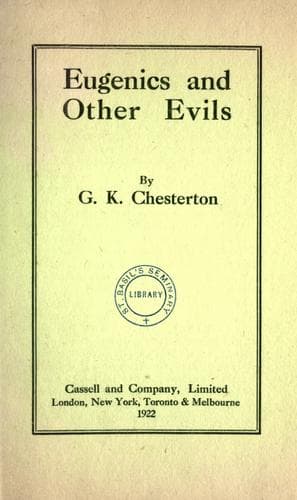
Eugenics and Other EvilsChesterton, G. K. (Gilbert Keith)
Philosophy
Eugenics and Other Evils
Chesterton, G. K. (Gilbert Keith)
Eugenics
However, he had made a mistake--as definite as a mistake in
multiplication. It may be summarised thus: that the same inequality
and insecurity that makes cheap labour may make bad labour, and at
last no labour at all. It was as if a man who wanted something from an
enemy, should at last reduce the enemy to come knocking at his door in
the despair of winter, should keep him waiting in the snow to sharpen
the bargain; and then come out to find the man dead upon the doorstep.
He had discovered the divine boomerang; his sin had found him out. The
experiment of Individualism--the keeping of the worker half in and
half out of work--was far too ingenious not to contain a flaw. It was
too delicate a balance to work entirely with the strength of the
starved and the vigilance of the benighted. It was too desperate a
course to rely wholly on desperation. And as time went on the terrible
truth slowly declared itself; the degraded class was really
degenerating. It was right and proper enough to use a man as a tool;
but the tool, ceaselessly used, was being used up. It was quite
reasonable and respectable, of course, to fling a man away like a
tool; but when it was flung away in the rain the tool rusted. But the
comparison to a tool was insufficient for an awful reason that had
already begun to dawn upon the master's mind. If you pick up a hammer,
you do not find a whole family of nails clinging to it. If you fling
away a chisel by the roadside, it does not litter and leave a lot of
little chisels. But the meanest of the tools, Man, had still this
strange privilege which God had given him, doubtless by mistake.
Despite all improvements in machinery, the most important part of the
machinery (the fittings technically described in the trade as "hands")
were apparently growing worse. The firm was not only encumbered with
one useless servant, but he immediately turned himself into five
useless servants. "The poor should not be emancipated," the old
reactionaries used to say, "until they are fit for freedom." But if
this downrush went on, it looked as if the poor would not stand high
enough to be fit for slavery.
Public-domain text, read in full here on John Shaqi.
Reviews
Reviews
No reviews yet
Be the first to share your thoughts on this work.
Elsewhere in the archive
Join the Discussion
Join the discussion
Sign in to leave a comment or review.
Sign InorCreate an account