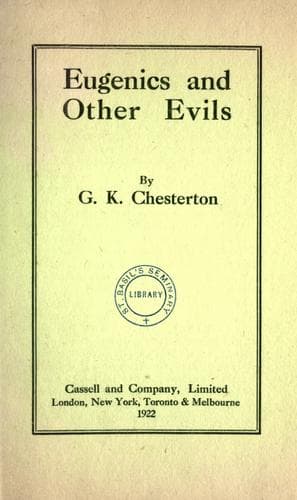
Eugenics and Other EvilsChesterton, G. K. (Gilbert Keith)
Philosophy
Eugenics and Other Evils
Chesterton, G. K. (Gilbert Keith)
Eugenics
This is the first evidence of motive: the ubiquitous assumption that
life and love must fit into a fixed framework of employment, even (as
in this case) of bad employment. The second evidence is the tacit and
total neglect of the scientific question in all the departments in
which it is not an employment question; as, for instance, the
marriages of the princely, patrician, or merely plutocratic houses. I
do not mean, of course, that no scientific men have rigidly tackled
these, though I do not recall any cases. But I am not talking of the
merits of individual men of science, but of the push and power behind
this movement, the thing that is able to make it fashionable and
politically important. I say, if this power were an interest in truth,
or even in humanity, the first field in which to study would be in the
weddings of the wealthy. Not only would the records be more lucid,
and the examples more in evidence, but the cases would be more
interesting and more decisive. For the grand marriages have presented
both extremes of the problem of pedigree--first the "breeding in and
in," and later the most incongruous cosmopolitan blends. It would
really be interesting to note which worked the best, or what point of
compromise was safest. For the poor (about whom the newspaper
Eugenists are always talking) cannot offer any test cases so complete.
Waiters never had to marry waitresses, as princes had to marry
princesses. And (for the other extreme) housemaids seldom marry Red
Indians. It may be because there are none to marry. But to the
millionaires the continents are flying railway stations, and the most
remote races can be rapidly linked together. A marriage in London or
Paris may chain Ravenna to Chicago, or Ben Cruachan to Bagdad. Many
European aristocrats marry Americans, notoriously the most mixed stock
in the world; so that the disinterested Eugenist, with a little
trouble, might reveal rich stores of negro or Asiatic blood to his
delighted employer. Instead of which he dulls our ears and distresses
our refinement by tedious denunciations of the monochrome marriages of
the poor.
Public-domain text, read in full here on John Shaqi.
Reviews
Reviews
No reviews yet
Be the first to share your thoughts on this work.
Elsewhere in the archive
Join the Discussion
Join the discussion
Sign in to leave a comment or review.
Sign InorCreate an account