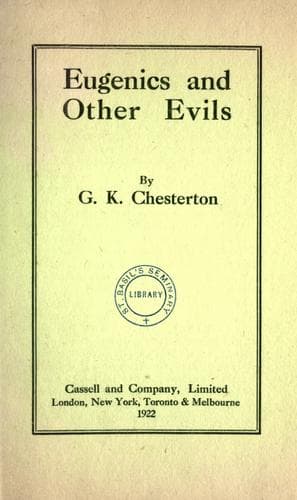
Eugenics and Other EvilsChesterton, G. K. (Gilbert Keith)
Philosophy
Eugenics and Other Evils
Chesterton, G. K. (Gilbert Keith)
Eugenics
For there is something really pathetic about the Eugenist's neglect of
the aristocrat and his family affairs. People still talk about the
pride of pedigree; but it strikes me as the one point on which the
aristocrats are almost morbidly modest. We should be learned Eugenists
if we were allowed to know half as much of their heredity as we are
of their hairdressing. We see the modern aristocrat in the most human
poses in the illustrated papers, playing with his dog or parrot--nay,
we see him playing with his child, or with his grandchild. But there
is something heartrending in his refusal to play with his grandfather.
There is often something vague and even fantastic about the
antecedents of our most established families, which would afford the
Eugenist admirable scope not only for investigation but for
experiment. Certainly, if he could obtain the necessary powers, the
Eugenist might bring off some startling effects with the mixed
materials of the governing class. Suppose, to take wild and
hypothetical examples, he were to marry a Scotch earl, say, to the
daughter of a Jewish banker, or an English duke to an American parvenu
of semi-Jewish extraction? What would happen? We have here an
unexplored field.
It remains unexplored not merely through snobbery and cowardice, but
because the Eugenist (at least the influential Eugenist)
half-consciously knows it is no part of his job; what he is really
wanted for is to get the grip of the governing classes on to the
unmanageable output of poor people. It would not matter in the least
if all Lord Cowdray's descendants grew up too weak to hold a tool or
turn a wheel. It would matter very much, especially to Lord Cowdray,
if all his employees grew up like that. The oligarch can be
unemployable, because he will not be employed. Thus the practical and
popular exponent of Eugenics has his face always turned towards the
slums, and instinctively thinks in terms of them. If he talks of
segregating some incurably vicious type of the sexual sort, he is
thinking of a ruffian who assaults girls in lanes. He is not thinking
of a millionaire like White, the victim of Thaw. If he speaks of the
hopelessness of feeble-mindedness, he is thinking of some stunted
creature gaping at hopeless lessons in a poor school. He is not
thinking of a millionaire like Thaw, the slayer of White. And this not
because he is such a brute as to like people like White or Thaw any
more than we do, but because he knows that _his_ problem is the
degeneration of the useful classes; because he knows that White would
never have been a millionaire if all his workers had spent themselves
on women as White did, that Thaw would never have been a millionaire
if all his servants had been Thaws. The ornaments may be allowed to
decay, but the machinery _must_ be mended. That is the second proof of
the plutocratic impulse behind all Eugenics: that no one thinks of
applying it to the prominent classes. No one thinks of applying it
Public-domain text, read in full here on John Shaqi.
Reviews
Reviews
No reviews yet
Be the first to share your thoughts on this work.
Elsewhere in the archive
Join the Discussion
Join the discussion
Sign in to leave a comment or review.
Sign InorCreate an account