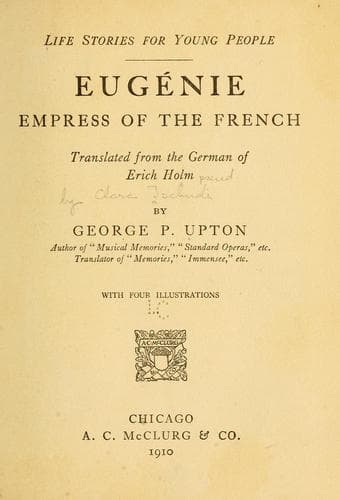
Eugénie, Empress, consort of Napoleon III, Emperor of the French, 1826-1920; Napoleon III, Emperor of the French, 1808-1873 -- Marriage
The lofty family traditions of the Kirkpatricks of Closeburn could
scarcely have been expected to be remembered amid the practical duties
of the merchant’s busy life, but his beautiful daughters were by no
means unaware of their high descent nor without hope of elevating
themselves once more to the rank of their ancestors. Of the four
sisters, Manuela, the third, was the most aspiring as well as the most
beautiful. Even when busy serving wine and chatting gayly with the
gentlemen who frequented her father’s wine-room, her mind was constantly
dwelling on the traditions of her house, and in the glories of the past
she forgot the sordid surroundings of the present. Although a true
daughter of the soil from which she sprang, Manuela was very different
from the ordinary Spanish girl, who is often indolent and ignorant; for
with her Scotch blood she inherited the energy without which her dreams
and ambitions could never have been realized. Determined to rise in the
world, and with nothing but herself and her beauty to depend upon, she
decided that only a brilliant marriage could accomplish her ends; and to
achieve this she was ready to use any means or make any sacrifice.
Among the officers stationed at that time in Malaga, most of whom were
frequent patrons of Kirkpatrick’s wine-room, was a colonel of artillery
in the Spanish army, Count Manuel Fernandez de Teba. No longer young,
and far from attractive in person, having lost an eye, and being very
short-sighted besides, he was little fitted to awaken tender sentiments
in the fair sex; but Manuela was not to be daunted by this. His heart
seemed a citadel not too difficult of conquest, and without regard to
his appearance she devoted herself to the study of his antecedents. The
result of these genealogical researches exceeded her fondest hopes, for
they proved that the bluest blood of Spain flowed in Count Teba’s veins.
He was descended from the noble Genoese family of Porto-Carrero, which,
emigrating to Estremadura in the fourteenth century, had secured by
marriage the right to bear some of the most illustrious names of Spain
as well as the heirship to the joint estates of Teba, Banos, and Mora.
He was the second son, it is true, but his elder brother was unmarried;
and if she united her future with his, the ambitious maiden could reckon
with some security on attaining in time the rank and position to which
she aspired.
Public-domain text, read in full here on John Shaqi.
Reviews
Reviews
No reviews yet
Be the first to share your thoughts on this work.
Join the Discussion
Join the discussion
Sign in to leave a comment or review.
Sign InorCreate an account