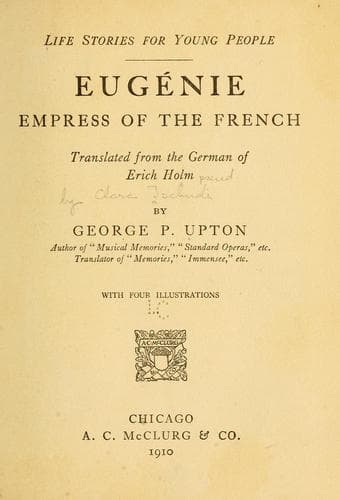
Eugénie, Empress, consort of Napoleon III, Emperor of the French, 1826-1920; Napoleon III, Emperor of the French, 1808-1873 -- Marriage
Eugénie’s life before her marriage was one of such freedom that although
she fulfilled all her duties as sovereign with dignity and apparent
content, there were many lonely hours when her thoughts turned longingly
to those youthful days in Spain and to the dear ones there, especially
her mother, with whom the Duchess of Alva was now her only link. The
Duchess had been afflicted for some time with an incurable malady,
though Eugénie was ignorant of its serious nature. While travelling with
the Emperor in August, 1860, she was shocked to receive word that her
sister’s condition had changed greatly for the worse. The august
travellers were then in Algiers, and Eugénie begged Napoleon to turn
back at once. But elaborate preparations had been made for their
entertainment and to abandon the festivities would have been too great a
disappointment to the people. Torn with anxiety, the Empress attended a
grand ball given in their honor, and not till it was over did she learn
the sad truth that her sister was dying. She sailed at once for France,
but it was too late. Before she reached land the Duchess had expired. It
was a terrible blow to Eugénie; overcome with grief she shut herself up
in her own apartments, refusing to see any one. It was months before she
recovered herself sufficiently to appear again in court circles.
Nor was this all. Although Napoleon’s marriage with the beautiful
Spaniard had been one of love alone, yet the passion with which she
inspired him gradually cooled, and although he continued to treat his
wife invariably with the same respect and admiration he had shown in
their early married life, there were many occasions when he gave her
cause for jealousy.
In these conjugal trials the Duchess of Alva had been her confidante and
had helped her through many bitter hours. Now that this gentle comforter
was gone she felt doubly the neglect so hard for her warm and generous
nature to endure; and these sorrows, added to anxiety for the health of
her son, cast a permanent shadow over her bright spirits. She fell more
and more under the influence of the priesthood, devoted herself to
religious works, had new convents built, and even thought of making a
pilgrimage to Jerusalem. This plan was afterwards abandoned, but her
irritability, capriciousness, and bigotry reduced her household to
desperation. The constant alternations of religious frenzy and feverish
pursuit of pleasure, of extreme gayety and deepest melancholy,
characteristic of the Empress’s later life, were no doubt due to an
overwrought nervous system, like the hysterical fits of laughing or
weeping that often seized her without any apparent cause. But with so
gay and sanguine a temperament as hers, these moods never lasted long;
and her warm-heartedness never failed to win the affection of those
about her.
Public-domain text, read in full here on John Shaqi.
Reviews
Reviews
No reviews yet
Be the first to share your thoughts on this work.
Join the Discussion
Join the discussion
Sign in to leave a comment or review.
Sign InorCreate an account