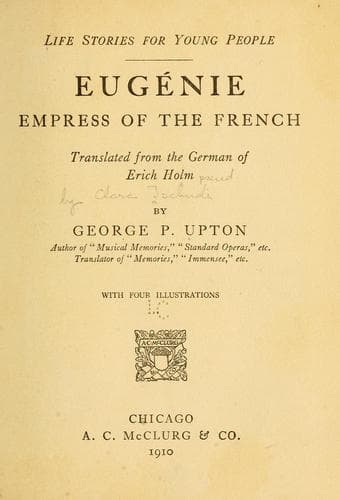
Eugénie, Empress, consort of Napoleon III, Emperor of the French, 1826-1920; Napoleon III, Emperor of the French, 1808-1873 -- Marriage
It had often been foretold him, even before he ascended the throne, that
Germany would be the cause of his undoing, and that was the reason why
he could neither bring himself to support national unity in that country
nor yet decide forcibly to oppose it. He had hoped the war between
Prussia and Austria would weaken both powers so that he might be able to
snatch the roast chestnuts safely from the fire; but Prussia’s decisive
victory left him helpless and irresolute, unable to nerve himself to any
decisive action. The increasing power of that country caused a growing
uneasiness throughout France, and the Emperor’s credit began to sink. He
tried to form new political alliances, but it seemed as if the hand of
fate, which at first had led him on from victory to victory, was now
against him, for he encountered only difficulties and disappointments.
To play the role of protector to the Latin peoples had always been a
part of Napoleon the Third’s policy. It was no slight blow to him,
therefore, when Isabella of Spain, with whom he was about to form an
alliance, was dethroned just as a meeting between them had been
arranged. She sought refuge in Paris, where she was received with royal
honors, and her son, afterwards King Alfonso the Twelfth, became the
constant playmate of the Prince Imperial.
[Illustration: _NAPOLEON THE THIRD_]
The revolution beyond the Pyrenees sounded the alarm for France, and
clouds of insurrection began to appear on the horizon. Napoleon found
himself forced to loosen the reins of government; and although the
disturbances apparently blew over, opposition increased daily. With
modification of the press laws in 1867 the situation grew worse instead
of better; and when in the following year Henri Rochefort began the
publication of “La Lanterne,” the waves of revolution began to rise.
This democratic Comte exercised a magical influence over public opinion
in Paris, and his scurrilous journal, filled with venomous attacks on
the whole imperial family, reached an enormous circulation. Napoleon’s
political blunders were not calculated to appease popular sentiment or
his own anxious forebodings. To add to his troubles, he suffered greatly
from a chronic physical ailment; and in the autumn of 1869 his health
was so seriously affected that there was some talk of declaring the
Prince Imperial of age, before the proper time. Eugénie’s popularity too
began to wane even among the middle classes, which had always formed her
strongest support.
Public-domain text, read in full here on John Shaqi.
Reviews
Reviews
No reviews yet
Be the first to share your thoughts on this work.
Join the Discussion
Join the discussion
Sign in to leave a comment or review.
Sign InorCreate an account