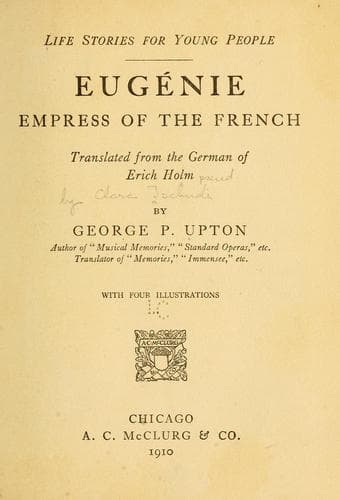
Eugénie, Empress, consort of Napoleon III, Emperor of the French, 1826-1920; Napoleon III, Emperor of the French, 1808-1873 -- Marriage
In spite of Eugénie’s continued refusal to mix in any public affairs,
the “salon at Chiselhurst” was persistently reported to be the centre of
political intrigue; and Prince Jerome Napoleon, who in the absence of
the Emperor wished to appear as head of the imperial family, presented
himself at Camden House one day to demand of the Empress an explanation.
A stormy scene followed between these two bitter enemies, and the “red
Prince” was careful that a properly distorted account of the interview
should be made public.
After an imprisonment of about seven months, Napoleon was at last free
to return to his wife and son at the little home in Chiselhurst, where
the imperial family continued to live in the simplest manner; for
although Camden House did not lack comfort and even elegance, it was so
limited as to space that it was impossible to accommodate more than one
or two guests at a time. Yet the joys of family life compensated in a
measure for all the luxury and state of which they had been deprived by
fortune, and in this smaller sphere Eugénie lost none of the dignity and
charm of manner for which she had been so conspicuous. It was the more
easy for her to adapt herself to these new conditions as gradually a
circle of their old friends began to gather about the exiles, and
expressions of loyalty and devotion arrived nearly every day from
France, with many proofs of friendship from Queen Victoria and other
royalties.
A great task still lay before her—to provide for the future of her son.
She had always been a wise as well as devoted mother, and had not failed
to impress on the young Prince that more would be required of him than
of others, in order properly to fit himself for the high position he
would one day be called upon to occupy. Now that the throne must be won
back again, it was doubly important that he should receive a thorough
military education. This son was now her only thought. She centred in
him all her hopes and expectations, for the Emperor’s health—which had
been poor for years—was now rapidly failing. She could never count on
Napoleon the Third’s return to the throne; but as the mother of Napoleon
the Fourth she saw herself in fancy once again in France, more highly
honored, even prouder and happier if possible, than before.
The chronic ailment from which the Emperor had always suffered
threatened, toward the close of 1872, to take a fatal turn and his
physicians advised an operation. Personally, Napoleon was strongly
opposed to it; but the Empress, not realizing the danger, and perhaps
with the secret hope that it might enable her husband to become once
more a power in French politics, urged him to yield to the physician’s
advice. He submitted accordingly to the operation, but had not strength
enough to recover from the shock; and on the ninth of January, 1873, the
“dreamer” passed quietly away without a word or a sign.
Chapter XIV
Death of Prince Imperial
Public-domain text, read in full here on John Shaqi.
Reviews
Reviews
No reviews yet
Be the first to share your thoughts on this work.
Elsewhere in the archive
Join the Discussion
Join the discussion
Sign in to leave a comment or review.
Sign InorCreate an account