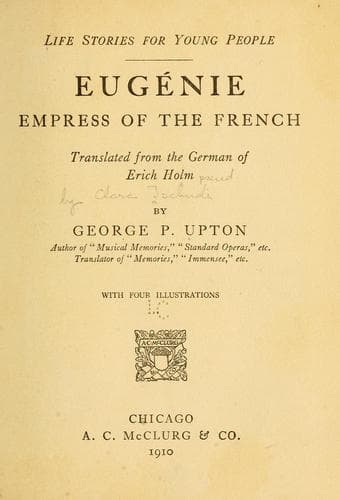
Eugénie, Empress, consort of Napoleon III, Emperor of the French, 1826-1920; Napoleon III, Emperor of the French, 1808-1873 -- Marriage
Eugénie’s grief at her husband’s death was deep and sincere. Over his
bier she wept far bitterer tears than those she had shed during those
dreadful days following her flight from the capital. Indeed she was so
prostrated as to be unable to appear at the funeral. Human nature is
elastic, however, and it was never the Empress’s way to fold her hands
and brood over her troubles. She found one source of consolation,
moreover, in the constant proofs of attachment that reached her, not
only from the friends that had remained faithful to her through all the
changes of fortune, but also from many others who had long seemed to
have forgotten their vows of allegiance.
As death had removed all possibility of the restoration of Napoleon the
Third to the throne, his old adherents rallied to the support of his
son; and as there was still a large Bonapartist party in France, it
seemed not improbable that with the exercise of courage and patience the
Empire might one day be revived. In 1873, by uniting with the
Legitimists and Orleanists, they succeeded in deposing Thiers, who had
been President of the Republic since 1871, and electing Marshal MacMahon
in his place, a change greatly to the advantage of the Bonapartists, who
now entered the political arena once more as a regular party.
In the Autumn of 1872 the Prince Imperial entered the military academy
at Woolwich, where he studied hard and made gratifying progress; and on
the death of his father he was generally recognized as heir to the
imperial throne, in spite of all the efforts made by his cousin Napoleon
to prevent it. Eugénie now lived only in this son and his future; no
stone was left unturned to smooth his pathway to the throne. As yet he
had a hard struggle before him; but her faith in his ultimate victory
was supreme; and supported by ex-Minister Rouher, the leader of the
Bonapartists, then as ever one of Eugénie’s stanchest friends, she
carefully but firmly gathered up the threads by which she hoped to guide
the course of events.
Public-domain text, read in full here on John Shaqi.
Reviews
Reviews
No reviews yet
Be the first to share your thoughts on this work.
Elsewhere in the archive
Join the Discussion
Join the discussion
Sign in to leave a comment or review.
Sign InorCreate an account