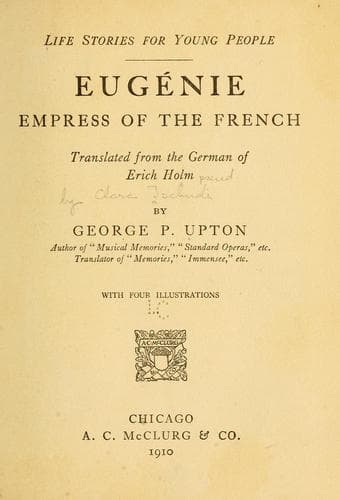
Eugénie, Empress, consort of Napoleon III, Emperor of the French, 1826-1920; Napoleon III, Emperor of the French, 1808-1873 -- Marriage
On the seventh of February, 1875, the Prince passed the required
examinations and left Woolwich with an officer’s commission. He had
developed greatly in every respect, to his mother’s joy and the pride of
his party, whose hopes were now fixed on him. His amiability and charm
of manner won him friends wherever he went. Unlike his father, he
objected strongly to any radical measures or political agitation of any
sort, and hoped to recover what he considered his rightful crown by the
natural allegiance of France. Besides her political ambitions for her
son, Eugénie was anxious also to arrange a suitable marriage for him;
but in this she was disappointed. The wooing of Napoleon the Fourth met
with the same fate as that of his father. There were repeated rumors of
a betrothal between him and Queen Victoria’s youngest daughter,
Beatrice, who is said to have cherished a warmer feeling than friendship
for the exiled Prince; but, deep as was the sympathy felt for him by the
English royal house, and true a friend as Victoria had proved herself,
to entrust her daughter’s fate to young Napoleon seemed to her a trifle
too uncertain. When this plan failed, Eugénie fixed her hopes on the
Princess Thyra of Denmark; and in 1878 the Prince made a visit to that
country to try his fortune with the Danish court; but here, too, he was
rejected as a suitor.
The Bonapartists now felt that to have any serious hope of gaining the
French crown the Prince must first win his laurels as a soldier; they
urged him, therefore, to join the English army, which was about to go to
war with the Kaffirs of Zulu. Much as she desired to see her son seated
on the throne, Eugénie shrank from this method of achieving it; but the
Prince fell in at once with the suggestion, and unmoved by his mother’s
attempts to dissuade him, sailed for Africa with the English troops,
leaving a message of farewell to his followers.
On the ninth of April, 1879, he arrived at the headquarters of the
commander-in-chief, Lord Chelmsford, and took part in several actions
with great spirit and courage. In May, while he was on a reconnoitring
expedition in the neighborhood of Itelezi with a fellow officer and
several men, the party was suddenly surprised by a band of Zulus who
sprang out from behind an ambuscade. Abandoned by his companions, who
fled to save themselves, the Prince held out bravely as long as he
could, but at length one of the savages dealt him a fatal blow, and he
fell, his body pierced with seventeen spears. The _Military Gazette_, in
which the young Prince received honorable mention, says:
“Thus did an inscrutable fate grant to him what it cruelly denied both
his father and the great founder of their race—to fall in battle,
bravely fighting against the foe.”
Public-domain text, read in full here on John Shaqi.
Reviews
Reviews
No reviews yet
Be the first to share your thoughts on this work.
Elsewhere in the archive
Join the Discussion
Join the discussion
Sign in to leave a comment or review.
Sign InorCreate an account