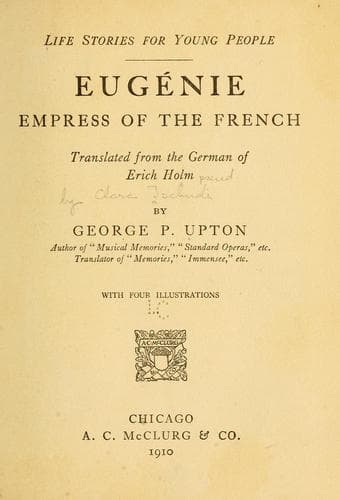
Eugénie, Empress, consort of Napoleon III, Emperor of the French, 1826-1920; Napoleon III, Emperor of the French, 1808-1873 -- Marriage
Early in the morning of the day of the funeral, July 12, Queen Victoria
arrived at Camden House with her daughters Alice and Beatrice, and with
her own hands laid a laurel wreath of gold upon the coffin. Many other
royal and distinguished personages followed, and the expression of
genuine sorrow visible on every face lent an air of remarkable solemnity
to the occasion. The Archbishop of Southwark performed the burial rites
for which some of the most famous opera singers had proffered their
services. Those of Madame Caters and Christine Nilsson were accepted;
but the latter, some of whose happiest memories were associated with the
palmy days of the Empire, and who had then considered it her highest
honor to sing before the now broken-hearted Empress, was for the first
time unequal to her task. Her voice failed, and she burst into tears.
* * * * * * * *
Broken by mental and physical suffering, the ex-Empress Eugénie still
lives on, awaiting the moment of release that shall reunite her with
those dearest to her on earth. She made a pilgrimage to Zululand to see
the spot where her son met his death. She has frequented various
watering-places seeking relief from the physical infirmities from which
she suffers. She visits many hospitals and charitable institutions to
minister to the sick and wounded; yet these acts of mercy serve only to
revive her sorrows, and emphasize the void in her lonely life.
From Chiselhurst, which held so many painful memories, she moved to
Farnborough, whither she also had the bodies of the Emperor and the
Prince Imperial conveyed. With the Queen of England Eugénie enjoyed the
same close friendship as in earlier years, and until the time of
Victoria’s death she was a frequent visitor at Windsor, although she
never appeared at any Court festivities. She still receives frequent
proofs of loyalty from France, and every year on her birthday she is
overwhelmed with flowers and good wishes. Yet nothing can rouse her from
her melancholy. Whole days and nights she sits brooding over the past,
haunted by faces and presentiments of death. At one time her attendants
even found it necessary to remove all the portraits of her husband and
son in order to preserve her reason.
A sad change has also taken place in her appearance. Portraits of her in
the early days of her widowhood show a still attractive figure whose
unhappy fate is suggested only by her mourning and the lines about the
eyes. But years such as she has since experienced count heavily. Her
hair is now snowy white. The slender figure is bowed with age and grief.
Scarce a trace is left of her wonderful charm and fascination, and in
the pale mourner with sunken eyes and faltering step there is no longer
the faintest resemblance to the once beautiful and splendor-loving
Empress.
[Illustration: _THE EMPRESS-WIDOW_]
Public-domain text, read in full here on John Shaqi.
Reviews
Reviews
No reviews yet
Be the first to share your thoughts on this work.
Elsewhere in the archive
Join the Discussion
Join the discussion
Sign in to leave a comment or review.
Sign InorCreate an account