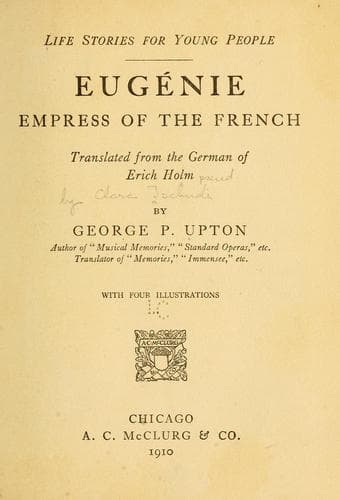
Eugénie, Empress, consort of Napoleon III, Emperor of the French, 1826-1920; Napoleon III, Emperor of the French, 1808-1873 -- Marriage
Republican, not to say radical, as the French capital was at that time,
the death of the Prince Imperial caused general consternation. The
Empire was still fresh in the minds of all. At the birth of the
Emperor’s son innumerable prayers had been offered for both mother and
child. Step by step the affections of the gay Parisians followed the
little Prince, and when at the age of three he rode with his mother to
Notre Dame to the thanksgiving services for the victory of Solferino,
the state coach was scarcely able to make its way through the admiring
and enthusiastic throngs. Since that day the Napoleonic dynasty had
suffered many reverses. The Empress, once the pride and glory of her
subjects, was an exile, surrounded by only a few friends, and living in
comparative poverty. Now she had suffered the last and heaviest blow of
fate in the loss of her only child. Yet many more hearts went out to
Eugénie in this hour of trial than in the days of her prosperity. Great
and small, rich and poor, friend and foe, united in heart felt sympathy
for the grief-stricken mother. But it was a grief that was beyond
consolation. She had done with life. “All is finished,” were the words
she constantly repeated, and sobbing aloud would bury her face in her
hands to shut out the awful vision that was always before her—the body
of her son pierced with cruel spear-wounds.
* * * * * * * *
When the remains of the Prince Imperial, which had been sent back to
England under a military escort, were borne into the hall at Camden
House by some of his former comrades at Woolwich, a single cry of
anguish escaped the Empress, but she did not shed a tear. All night she
remained on her knees in prayer beside the coffin; at dawn, when the
flame of the wax tapers began to pale in the growing light, she heard
mass, after which she shut herself closely in her own room and did not
leave it again till after the funeral services were over.
The burial of Napoleon the Third had been only the usual drama enacted
in every family when a beloved one is laid to his last rest, but that of
the Prince Imperial was a scene that touched even the coldest and most
indifferent, and excited world-wide interest. At the Emperor’s death,
despite their grief, the mourners had looked with hope and confidence
toward his son; now this last hope had vanished, and tears were seen
even on the cheeks of grizzled veterans. Where hundreds had accompanied
the father’s remains to their resting-place, the son’s bier was followed
by thousands of every rank and station.
Public-domain text, read in full here on John Shaqi.
Reviews
Reviews
No reviews yet
Be the first to share your thoughts on this work.
Elsewhere in the archive
Join the Discussion
Join the discussion
Sign in to leave a comment or review.
Sign InorCreate an account