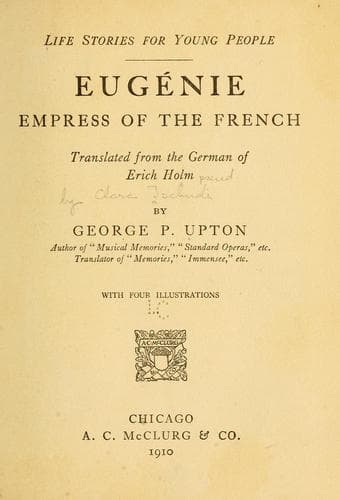
Eugénie, Empress, consort of Napoleon III, Emperor of the French, 1826-1920; Napoleon III, Emperor of the French, 1808-1873 -- Marriage
In spite of her many extravagances, however, Eugénie’s youth was marked
by a gay thoughtlessness and daring that were most attractive. Her
self-reliant nature could brook no restraint. She scorned prudence and
yielded rashly to every impulse. The attention she attracted could not
fail to furnish food for gossip, and malicious tongues were soon busy
with her reputation—a fact which did not deter her in the least from
pursuing her fondness for adventure. This indifference to public opinion
also led her, unfortunately, to defy custom and snap her fingers at the
strict etiquette prescribed at court. At last she went out alone one
evening with one of the young pages for a long walk. Whispers of this
romantic promenade soon reached the ears of Queen Isabella, who, though
setting the worst possible example herself in regard to morals, insisted
on the strictest propriety in the behavior of her ladies; and both
culprits were summarily dismissed from her service.
Like all Spanish girls, Eugénie had been brought up from her earliest
years a devout Catholic, with the deepest reverence for the Pope and the
Roman religion, a devotion that in time became almost fanaticism and
furnished her enemies with a weapon of attack against which she was
powerless to defend herself. After her dismissal from court she began to
reflect on the difference between a religious life and one of idle
pleasure. While at the convent, the contrast between the unselfish
devotion of the nuns and the atmosphere of her parents’ disordered
household made a deep impression on the young girl’s mind, and the
Church seemed a blissful refuge from the storms of life. Now—feeling
more and more conscious of the void within her—a passion for religion
seized her, a longing to escape from the world of lies and slander in
which she lived, into a purer atmosphere, a new field of activity. The
Church held out its arms to her, and in them she determined to seek
relief and to find strength to devote her life to the poor and
suffering. It is said that when Eugénie went to the convent prepared to
take the vows, an old half-witted nun approached, gazed at her with
dull, vacant eyes, and suddenly exclaimed, “My daughter, do not seek
shelter behind our walls. You are destined to adorn a throne!”
In her state of religious ecstasy these words could not fail to impress
Eugénie deeply. It seemed a voice from heaven, speaking to her through
the nun and consecrating her to the world. The Countess Montijo, too,
did all she could to strengthen her daughter in this conviction, and
persuaded her at length, instead of burying herself in a cloister, to
travel abroad with her again.
Chapter II
Eugénie’s Marriage to Louis Napoleon
Public-domain text, read in full here on John Shaqi.
Reviews
Reviews
No reviews yet
Be the first to share your thoughts on this work.
Join the Discussion
Join the discussion
Sign in to leave a comment or review.
Sign InorCreate an account