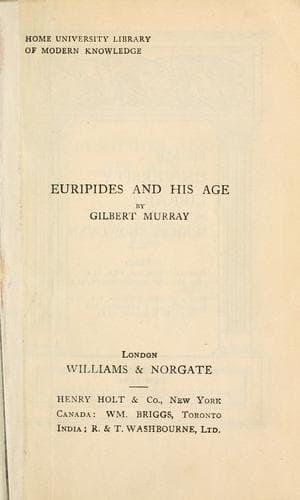
Euripides -- Criticism and interpretation; Mythology, Greek, in literature; Tragedy
Most of the volumes of this series are occupied with large subjects and
subjects commonly recognized as important to great masses of people at
the present day. In devoting the present volume to the study of a single
writer, remote from us in time and civilization and scarcely known by
more than name to many readers of the Library, I am moved by the belief
that, quite apart from his disputed greatness as a poet and thinker,
apart from his amazing and perhaps unparalleled success as a practical
playwright, Euripides is a figure of high significance in the history of
humanity and of special interest to our own generation.
Born, according to the legend, in exile and fated to die in exile,
Euripides, in whatever light one regards him, is a man of curious and
ironic history. As a poet he has lived through the ages in an
atmosphere of controversy, generally--though by no means always--loved
by poets and despised by critics. As a thinker he is even to this day
treated almost as a personal enemy by scholars of orthodox and
conformist minds; defended, idealized and sometimes transformed beyond
recognition by various champions of rebellion and the free intellect.
The greatest difficulty that I feel in writing about him is to keep in
mind without loss of proportion anything like the whole activity of the
many-sided man. Recent writers have tended to emphasize chiefly his work
as a destructive thinker. Dr. Verrall, the most brilliant of all modern
critics of Euripides, to whose pioneer work my own debt is greater than
I can well express, entitled one of his books "Euripides the
Rationalist" and followed to its extreme limit the path indicated by
this particular clue. His vivid and interesting disciple Professor
Norwood has followed him. In Germany Dr. Nestlé, in a sober and learned
book, treating of Euripides as a thinker, says that "all mysticism was
fundamentally repugnant to him"; a view which is certainly wrong, since
some of the finest expressions of Greek mysticism known to us are taken
from the works of Euripides. Another good writer, Steiger, draws an
elaborate parallel between Euripides and Ibsen and finds the one key to
Euripides in his realism and his absolute devotion to truth. Yet an
older generation of Euripides-lovers felt these things quite
differently. When Macaulay proclaimed that there was absolutely nothing
in literature to equal _The Bacchae_, he was certainly not thinking
about rationalism or realism. He felt the romance, the magic, the sheer
poetry. So did Milton and Shelley and Browning. And so did the older
English scholars like Porson and Elmsley. Porson, while admitting that
the critics have many things to say against Euripides as compared, for
instance, with Sophocles, answers in his inarticulate way "_illum
admiramur, hunc legimus_"--"we admire the one, but we read the other."
Elmsley, so far from regarding Euripides as mainly a thinker, remarks in
passing that he was a poet singularly addicted to contradicting himself.
Public-domain text, read in full here on John Shaqi.
Reviews
Reviews
No reviews yet
Be the first to share your thoughts on this work.
Join the Discussion
Join the discussion
Sign in to leave a comment or review.
Sign InorCreate an account