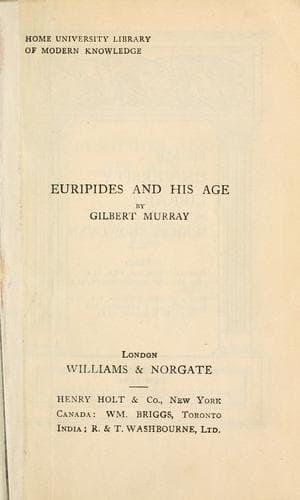
Euripides -- Criticism and interpretation; Mythology, Greek, in literature; Tragedy
This distinction is often strongly marked in the practice of different
artists. One poet may be both a pioneer of new roads in thought and a
breaker of the laws of technique, like Walt Whitman--an enemy of the
tradition in both kinds. Another may be slack and anarchical in his
technique though quite conventional in his thought. I refrain from
suggesting instances. Still more clearly there are poets, such as
Shelley or Swinburne, whose works are full of intellectual rebellion
while their technique is exquisite and elaborate. The thoughts are bold
and strange. The form is the traditional form developed and made more
exquisite.
Now Euripides, except for some so-called licences in metre, belongs in
my judgment markedly to the last class. In speculation he is a critic
and a free lance; in artistic form he is intensely traditional. He seems
to have loved the very stiffnesses of the form in which he worked. He
developed its inherent powers in ways undreamed of, but he never broke
the mould or strayed away into shapelessness or mere realism. His last,
and in many respects his greatest, play, the _Bacchae_, is, as far as
our evidence goes, the most formal that he ever wrote.
These, then, are the lights in which we propose to look at Euripides. In
attempting to reconstruct his life we must be conscious of two
backgrounds against which he will be found standing, according as we
regard him as Thinker or as pure Artist. We must first try to understand
something of the tradition of thought in which he was reared, that is
the general atmosphere of fifth century Athens, and watch how he
expressed it and how he reacted against it. Next, we must understand
what Greek tragedy was, what rituals and conventions held it firm, and
what inner fire kept it living, and so study the method in which
Euripides used it for his chosen mode of expression, obeying its laws
and at the same time liberating its spirit.
CHAPTER II
THE SOURCES FOR A LIFE OF EURIPIDES: THE MEMORIES REMAINING IN THE FOURTH
CENTURY: HIS YOUTH AND ITS SURROUNDINGS: ATHENS AFTER THE PERSIAN WAR:
THE GREAT SOPHISTS
Public-domain text, read in full here on John Shaqi.
Reviews
Reviews
No reviews yet
Be the first to share your thoughts on this work.
Join the Discussion
Join the discussion
Sign in to leave a comment or review.
Sign InorCreate an account