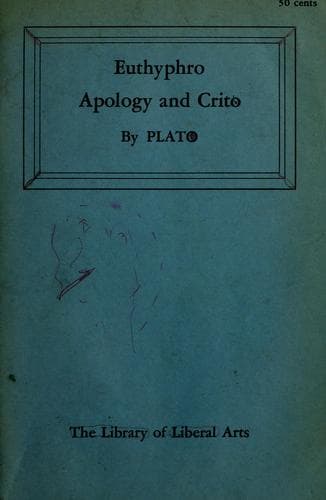
Classical literature; Philosophy, Ancient; Piety -- Early works to 1800; Socrates, 470 BC-399 BC
The subtle connection with the Apology and the Crito; the holding back
of the conclusion, as in the Charmides, Lysis, Laches, Protagoras, and
other Dialogues; the deep insight into the religious world; the dramatic
power and play of the two characters; the inimitable irony, are reasons
for believing that the Euthyphro is a genuine Platonic writing. The
spirit in which the popular representations of mythology are denounced
recalls Republic II. The virtue of piety has been already mentioned
as one of five in the Protagoras, but is not reckoned among the four
cardinal virtues of Republic IV. The figure of Daedalus has occurred in
the Meno; that of Proteus in the Euthydemus and Io. The kingly science
has already appeared in the Euthydemus, and will reappear in the
Republic and Statesman. But neither from these nor any other indications
of similarity or difference, and still less from arguments respecting
the suitableness of this little work to aid Socrates at the time of his
trial or the reverse, can any evidence of the date be obtained.
EUTHYPHRO
PERSONS OF THE DIALOGUE: Socrates, Euthyphro.
SCENE: The Porch of the King Archon.
EUTHYPHRO: Why have you left the Lyceum, Socrates? and what are you
doing in the Porch of the King Archon? Surely you cannot be concerned in
a suit before the King, like myself?
SOCRATES: Not in a suit, Euthyphro; impeachment is the word which the
Athenians use.
EUTHYPHRO: What! I suppose that some one has been prosecuting you, for I
cannot believe that you are the prosecutor of another.
SOCRATES: Certainly not.
EUTHYPHRO: Then some one else has been prosecuting you?
SOCRATES: Yes.
EUTHYPHRO: And who is he?
SOCRATES: A young man who is little known, Euthyphro; and I hardly know
him: his name is Meletus, and he is of the deme of Pitthis. Perhaps you
may remember his appearance; he has a beak, and long straight hair, and
a beard which is ill grown.
EUTHYPHRO: No, I do not remember him, Socrates. But what is the charge
which he brings against you?
SOCRATES: What is the charge? Well, a very serious charge, which shows
a good deal of character in the young man, and for which he is certainly
not to be despised. He says he knows how the youth are corrupted and
who are their corruptors. I fancy that he must be a wise man, and seeing
that I am the reverse of a wise man, he has found me out, and is going
to accuse me of corrupting his young friends. And of this our mother the
state is to be the judge. Of all our political men he is the only one
who seems to me to begin in the right way, with the cultivation of
virtue in youth; like a good husbandman, he makes the young shoots his
first care, and clears away us who are the destroyers of them. This is
only the first step; he will afterwards attend to the elder branches;
and if he goes on as he has begun, he will be a very great public
benefactor.
Public-domain text, read in full here on John Shaqi.
Reviews
Reviews
No reviews yet
Be the first to share your thoughts on this work.
Join the Discussion
Join the discussion
Sign in to leave a comment or review.
Sign InorCreate an account