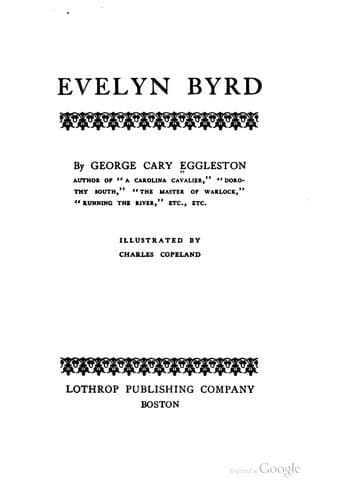
Virginia -- History -- Civil War, 1861-1865 -- Fiction
The question was indeed a very perplexing one. How should he even
begin the proposed conversation? Should he begin by abruptly telling
Evelyn that he loved her, but that there were reasons why he did not
want her to give him love in return? That was not the way in which a
woman had a right to expect to be wooed. It would be a direct affront
to her womanly and maidenly pride, which she would promptly, and
bitterly, and quite properly, resent. Moreover, by arousing her anger
and resentment, it would utterly defeat his purpose, which was to find
out his own duty by finding out how far Evelyn had already learned to
think of him as a possible lover.
Should he, then, ask her that question, in her own singularly direct
and truthful way of dealing?
That would be to affront and wound her by the assumption that she had
given her love unasked.
Should he begin by explaining to her the circumstances which prompted
him to shrink from wooing her, and then offer her his love if she
wanted it?
Nothing could be more preposterous than that.
Should he simply pay her his addresses, ask her for her love, and
then, if she should give it, proceed to explain to her the reasons why
she should not have permitted herself to love such a man as he?
That question also promptly answered itself in the negative, with
emphasis.
What, then, should he do?
Clearly it would be better to await Evelyn’s return to Wyanoke, and
trust to good luck to open some possible way. At any rate, he might
there approach the subject in indirect ways; while if he could have
ridden over to Branton for the express purpose of having a conference
with her, no such indirection would have been possible. His very going
to her there would have been a declaration of some purpose which he
must promptly explain.
Obviously, therefore, it was better that he should not go to Branton,
but should await such opportunity as good fortune might give him after
Evelyn’s return to Wyanoke. But that necessity postponed the outcome,
and Kilgariff was in a mood to be impatient of delay, particularly as
every hour consciously intensified his own love, and rendered him less
and less capable of saying nay to his passion.
With her woman’s quickness of perception, Dorothy shrewdly guessed
what was going on in his mind, and she rejoiced in it. But she made
no reference to the matter, even in the most remotely indirect way.
She simply went about her tasks with a pleased and amused smile on her
face.
XXVIII
EVELYN’S BOOK, CONCLUDED
WHEN Dorothy took up Evelyn’s manuscript again, it was nine o’clock in
the evening of the second day, and, moved by her eagerness to follow
the story, even more than by her conscientious desire to finish it
before the author’s return on the morrow, she read late into the night.
But she had sent Evelyn a note in the late afternoon, in which she had
written:—
Public-domain text, read in full here on John Shaqi.
Reviews
Reviews
No reviews yet
Be the first to share your thoughts on this work.
Elsewhere in the archive
Join the Discussion
Join the discussion
Sign in to leave a comment or review.
Sign InorCreate an account