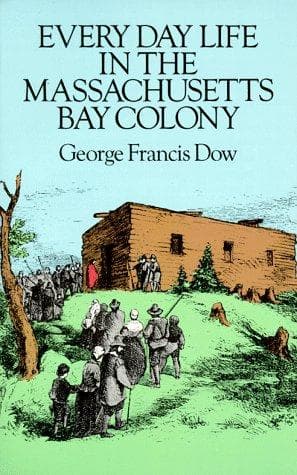
Every Day Life in the Massachusetts Bay ColonyDow, George Francis
History
Every Day Life in the Massachusetts Bay Colony
Dow, George Francis
Massachusetts -- Social life and customs -- To 1775
Just forward of the cabin was the steerage filled with immigrants
of all ages. Their beds were made up on the deck where they lay
alongside of each other and in this low-studded space they existed
when the hatches were battened down in stormy weather. "They have
only for a grown person per week, one pound neck beef, or spoilt
pork, two pounds oat meal, with a small quantity of bisket, not only
mouldy, but absolutely crumbled down with damp, wet and rottenness.
The half is only allowed a child, so that if they had not potatoes,
it is impossible they could live out the voyage. They have no drink,
but a very small proportion of brakish bad water."
It is quite plain that eighteenth-century trans-Atlantic voyaging
was full of discomfort to the average traveler, and to the
unfortunate in the steerage a fearful adventure.
CHAPTER XII
FROM WAMPUM TO PAPER MONEY
The early settlers of New England had little coinage for circulation
and were driven to the necessity of using the produce of the soil
and the live stock from their pastures as their media of exchange.
Peltry also was one of the first and for many years the principal
article of currency. It was offered in great abundance by the
Indians who were very ready to barter it for beads, knives, hatchets
and blankets and especially for powder, shot, guns and "strong
water."
In most of the Colonies the wampum of the Indians also was
extensively used and frequently was paid into the treasury in
payment of taxes. So, also, were cattle and corn as is shown
by numerous enactments of the Great and General Court of the
Massachusetts Bay. Musket balls were also current and were made
legal tender by order of the Court which decreed "that musket
bullets of a full bore shall pass current for a farthing a piece
provided that no man be compelled to take more than 12 pence at a
time of them." In Virginia, tobacco was used for currency and "from
100 to 150 pounds of it bought many a man a good wife."
The Indian wampum was perhaps the most convenient currency
available. It is described by Roger Williams who, perhaps, had a
better knowledge of it than most of the early colonists. He says:
"It is of two kinds which the Indians make of the stem or the stock
of the periwinkle after all the shell is broken off. [The periwinkle
is a mollusc, more common south of Cape Cod than along the shores
of Massachusetts Bay.] Of this kind, six of the small beads, which
they make with holes to string upon their bracelet, are current
with the English for a penny. The other kind is black, inclined
to a blue shade, which is made of the shell of a fish [that is, a
mollusc] which some of the English call henspoquahoc [now known as
the hen-clam or quahaug] and of this description three are equal to
an English penny. One fathom of this stringed money is worth five
shillings."
Public-domain text, read in full here on John Shaqi.
Reviews
Reviews
No reviews yet
Be the first to share your thoughts on this work.
Elsewhere in the archive
Join the Discussion
Join the discussion
Sign in to leave a comment or review.
Sign InorCreate an account