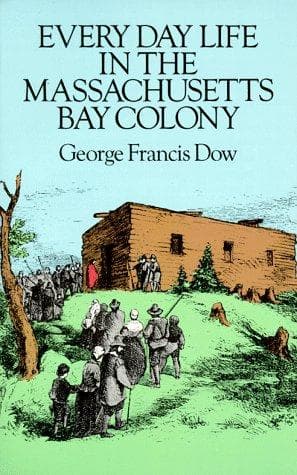
Every Day Life in the Massachusetts Bay ColonyDow, George Francis
History
Every Day Life in the Massachusetts Bay Colony
Dow, George Francis
Massachusetts -- Social life and customs -- To 1775
The _Gazette_ states that the examination gave great occasion to
conclude that they were concerned in the poisoning, and a week after
the inquest they were arrested and confined in the ancient jail in
Salem where the persons accused of witchcraft were imprisoned many
years before. They were indicted and brought to trial. John Adams,
afterwards President of the United States, then thirty-four years
of age, was counsel for the accused. Jonathan Ames turned King's
evidence against his mother. It was midnight before the counsel
began their arguments and two of the three judges were explicit in
summing up the evidence, that there was "a violent presumption"
of guilt, but at nine o'clock in the morning the jury came in and
rendered a verdict of "not guilty." May the result be attributed
to John Adams's eloquence and logic or to the vagaries of our jury
system?
But we are a long way from the third session of the Court of
Assistants held September 28, 1630. Not until this time did the
law begin to reach out for its victims. John Goulworth was ordered
whipped and afterwards set in the stocks for felony, not named. One
other was whipped for a like offence and two Salem men, one of whom
has given us an honored line of descendants, were sentenced to sit
in the stocks for four hours, for being accessory thereunto. Richard
Clough's stock of strong water was ordered seized upon, because of
his selling a great quantity thereof to servants, thereby causing
much disorder. No person was to permit any Indian to use a gun
under a penalty of £10. Indian corn must not be sold or traded with
Indians or sent away without the limits of the Patent. Thomas Gray
was enjoined to remove himself out of the Patent before the end of
March, and the oath was administered to John Woodbury, the newly
elected constable from Salem.
At the next session William Clark, who had been brought to book
at a previous Court for overcharging Mr. Baker for cloth, now
was prohibited cohabitation and frequent keeping company with
Mrs. Freeman and accordingly was placed under bonds for a future
appearance. Three years later this offender became one of the twelve
who went to Agawam and founded the present town of Ipswich, and ten
years later still another William Clark of Ipswich was sentenced to
be whipped "for spying into the chamber of his master and mistress
and reporting what he saw."
November 30, 1630, Sir Richard Saltonstall was fined £5, for
whipping two persons without the presence of another assistant, as
required by law; while Bartholomew Hill was whipped for stealing a
loaf of bread, and John Baker suffered the same penalty for shooting
at wild fowl on the Sabbath Day. And so continues the record of
intermingled punishment and legislation.
Public-domain text, read in full here on John Shaqi.
Reviews
Reviews
No reviews yet
Be the first to share your thoughts on this work.
Elsewhere in the archive
Join the Discussion
Join the discussion
Sign in to leave a comment or review.
Sign InorCreate an account