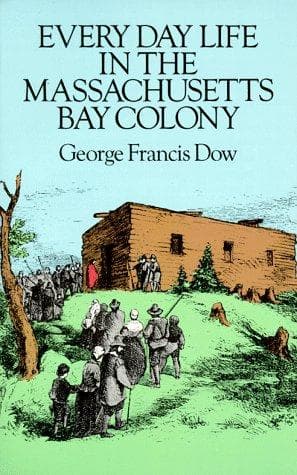
Every Day Life in the Massachusetts Bay ColonyDow, George Francis
History
Every Day Life in the Massachusetts Bay Colony
Dow, George Francis
Massachusetts -- Social life and customs -- To 1775
While we are discussing matters relating to the Sabbath and to
the church it may be well to allude to the ministry. It has been
shown that the first concern of the Court of Assistants was a
provision for the housing and care of the ministry. Much the larger
number were godly men actuated by a sincere desire to serve their
people and to preserve their souls. But many of them were men, not
saints, and so possessed of men's passions and weaknesses. While
all exercised more or less influence over the communities in which
they lived, yet the tangible result must have been negative in some
instances. Take for example the small inland town of Topsfield,
settled about 1639. Rev. William Knight rendered mission service
for a short time early in the 40's and a dozen years later Rev.
William Perkins moved into town from Gloucester. He had been one
of the twelve who settled the town of Ipswich in 1633; afterwards
he lived at Weymouth where he was selectman, representative to the
General Court, captain of the local military company and also a
member of the Ancient and Honorable Artillery Company. He also was
schoolmaster in 1650 and the next year appears at Gloucester as
minister, from which place he soon drifted into Court. Cross suits
for defamation and slander were soon followed by the presentment of
Mrs. Holgrave for unbecoming speeches against Mr. Perkins, saying
"if it were not for the law, shee would never come to the meeting,
the teacher was so dead ... affirming that the teacher was fitter
to be a ladys chamberman, than to be in the pulpit."
Mr. Perkins removed to Topsfield in 1656. The next year he tried
to collect his salary by legal process and again in 1660. Three
years later a church was organized and their first minister was
settled. He was a Scotchman--Rev. Thomas Gilbert. Soon Mr. Perkins
was summoned to Salem Court where Edward Richards declared in court
before Mr. Perkins' face, that the latter being asked whither he
was going, said, to hell, for aught he knew. Of course Mr. Perkins
denied the testimony. Later in the same year he was fined for
excessive drinking, it appearing that he stopped at the Malden
ordinary and called for sack. But goody Hill told him that he had
had too much already and Master Perkins replied, "If you think I am
drunk let me see if I can not goe," and he went tottering about the
kitchen and said the house was so full of pots and kettles that he
could hardly go.
Public-domain text, read in full here on John Shaqi.
Reviews
Reviews
No reviews yet
Be the first to share your thoughts on this work.
Elsewhere in the archive
Join the Discussion
Join the discussion
Sign in to leave a comment or review.
Sign InorCreate an account