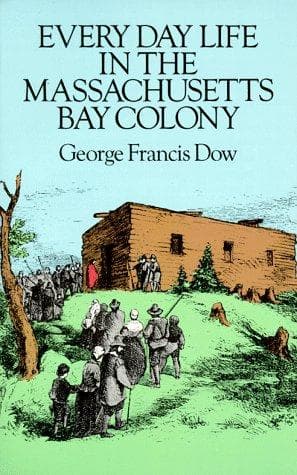
Every Day Life in the Massachusetts Bay ColonyDow, George Francis
History
Every Day Life in the Massachusetts Bay Colony
Dow, George Francis
Massachusetts -- Social life and customs -- To 1775
The home of the average New Englander in the late seventeenth
century was a wooden dwelling of two stories built around a brick
chimney containing large fireplaces. In Rhode Island and in parts
of Connecticut, where shale abounded, the chimney was built of
stone and not infrequently the house, in whole or at one end, was
also so constructed. The roofs of these houses were covered with
wooden shingles usually split from pine logs and shaved smooth by
hand on a shingle horse. The outside walls of the well made house
were covered with clapboards, also smoothed on the shingle horse.
For many years these clapboards were made from oak, but as this
wood has a tendency to warp and pull itself free from fastenings,
by the year 1700, its use for that purpose had very generally been
replaced by pine. Outbuildings and the poorer class of dwellings
were not covered with clapboards or only the part next the road, for
the New Englander believes in "putting his best foot forward." Such
buildings were covered with "weatherboards" or plain boarding that
lapped at the lower edge.
The windows in these houses were filled by casement sash containing
glass set in lead cames. The glass was usually diamond shaped, but
sometimes four by six inch lights were used. This glass was imported
from England and came packed in cribs, but much of it came in sheets
already leaded and was cut to size by "glaziers" upon demand. Early
in the eighteenth century sliding-sash windows were introduced,
probably about 1710, but it was a long time before existing
casements were entirely given up. One Saturday afternoon in July,
1714, lightning struck the house of Colonel Vetch in Boston. He had
bought the dwelling not long before and Judge Sewall records in his
diary that at the time of the storm "the Work of Transformation was
not finished" to make the building fit for the occupancy of Madam
Vetch. The lightning played various tricks with the house, doing
considerable damage, and among other details the Judge mentions
that it "lifted up the Sash Window and broke one of the squares" of
glass.[17] Colonel Vetch was presumably a man of substance for he
afterwards became Governor of Nova Scotia, and he is likely to have
"transformed" his recently purchased house into the latest fashion
of lighting.
[17] _Mass. Historical Society Colls._ (5th ser.), Vol. 7, p. 10.
Public-domain text, read in full here on John Shaqi.
Reviews
Reviews
No reviews yet
Be the first to share your thoughts on this work.
Join the Discussion
Join the discussion
Sign in to leave a comment or review.
Sign InorCreate an account