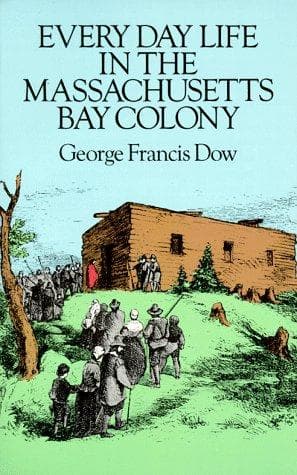
Every Day Life in the Massachusetts Bay Colony — John Shaqi
Every Day Life in the Massachusetts Bay ColonyDow, George Francis
History
Every Day Life in the Massachusetts Bay Colony
Dow, George Francis
Massachusetts -- Social life and customs -- To 1775
The brick oven was a feature of every chimney. Sometimes in early
days it was built partly outside the house but so far as known
the opening was always in the kitchen fireplace. To reach it the
housewife must stoop below the oaken lintel and stand inside the
fireplace, taking care that her woolen skirts did not come near the
flames. To heat it for a baking, a fire was built inside, usually
with specially prepared pine or birch wood that had been split and
seasoned out of doors for a short time and then housed. The fire
and ashes were then taken out by means of a peel--a long-handled,
flat-bladed shovel made for the purpose--and when dusted out with a
broom made of hemlock twigs it was ready for the brown bread, beans,
peas, Indian pudding, pies, and rye drop cakes which were made with
rye meal, eggs and milk and baked directly on the bricks in the
bottom of the oven.
Between the years of 1635 and 1655, court records and inventories
of estates in the Massachusetts Bay Colony mention the following
articles of food:
Bacon, beef, butter, cheese, eggs, fowls, lamb, milk, mutton, pork,
suet, veal, wild game, and cod, herring, mackerel, salmon and
sturgeon.
Barley, beans, Indian beans, bran, cabbages, carrots, chaff, corn,
English corn, Indian corn, hops, Indian meal, rye meal, oatmeal,
oats, parsnips, peas, pumpions, rye, squashes, turnips and wheat.
Apples, berries, fruit, honey, raisins, sugar and vinegar.
Biscuit, blewlman, bread, cake, malt, salad oil, porridge, rye malt,
yeast, salt and many kinds of spices.
Much of this food was raised on the farm and nearly every family
had its garden. Such articles of food as were imported were usually
obtained at the shops in the larger towns by barter, as money was
scarce. In 1651, a farmer came through the woods to Salem in his
cart bringing twelve bushels of rye. He stopped at a shop owned
by George Corwin and from the daybook kept at the time and still
carefully preserved, we learn that among other necessaries he
carried home sugar for the goodwife, and for the children a doll and
a bird whistle.
In the early years domestic animals were too valuable to be killed
for meat but game was plentiful and was roasted by being trussed on
iron spits resting on curved brackets on the backs of the andirons.
This, of course, required constant turning to expose the roast on
all sides in order to cook it evenly--a task frequently delegated to
a child. A skillet would be placed beneath to catch the drippings.
Sometimes a bird was suspended before the fire by a twisted cord
that would slowly unwind and partly wind again, requiring some
one in frequent attendance to twist the cord. Families of wealth
possessed a "jack" to turn the spit. This was a mechanism fastened
over the fireplace and connected with the spit by means of a pulley
and cord. A heavy weight suspended by a cord which slowly unwound,
supplied the power that turned the spit.
Public-domain text, read in full here on John Shaqi.
Reviews
Reviews
No reviews yet
Be the first to share your thoughts on this work.
Join the Discussion
Join the discussion
Sign in to leave a comment or review.
Sign InorCreate an account