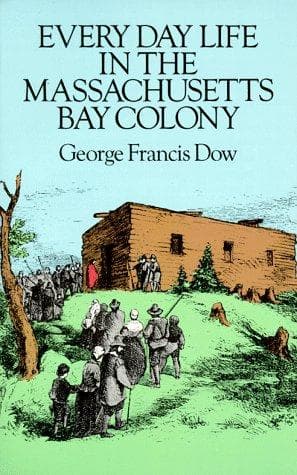
Every Day Life in the Massachusetts Bay ColonyDow, George Francis
History
Every Day Life in the Massachusetts Bay Colony
Dow, George Francis
Massachusetts -- Social life and customs -- To 1775
It is claimed by some that the floors were sanded. That certainly
was true at a later period but there are strong elements of doubt
as to the prevalence of this custom during the seventeenth century.
Sand, however, was used freely with home-made soft soap, to scrub
the floors which were always kept white and clean, and whenever
an early house is restored or taken down sand is always found,
sometimes in considerable quantity, where it has sifted down through
the cracks between the floor boards. The downstairs rooms had
double floors but the chamber floors were made of one thickness of
boards with here and there a knothole and frequently with cracks
between the boards through which the dust and dirt from above
must have sifted down upon the heads of those seated at dinner or
engaged in their daily tasks in the rooms below. Not only does the
structural evidence show this to be true but a number of instances
occur among the papers in Court files, where witnesses have deposed
as to what they had seen and heard through the cracks in chamber
floors. A grandson of Governor Endecott once fell a victim of two
gossiping sixteen-year-old girls who had spent some time on their
knees peeping through the cracks in a chamber floor. Capt. Richard
More, the last survivor of the company on the _Mayflower_, late in
life kept a tavern in Salem. He was spied upon in this manner and
eventually brought before the justices of the Quarterly Court to
answer for his evasion of the law set forth and maintained at that
time.
The parlor, called "the foreroom" at a later time, was the room
where guests of station were received. The best bed hung with
curtains and valance and covered with a rug, stood in a corner. In
those days rugs were not used on floors but as bed furnishings.
Even the baby's cradle had its rug. Carpets, likewise, were too fine
for wooden floors and were used as table covers. Of bedsteads there
were many kinds--high and low, canopy, close, corded, half-headed,
joined, side, standing, inlaid, and wainscot, and slipped under
the higher bedsteads during the daytime, were trundle or "truckle"
beds in which the children slept at night. Lionel Chute, the
schoolmaster, had an "old darnkell coverlet" on his bed while some
of his neighbors possessed branched and embroidered coverlets and
several had coverlets made of tapestry.
Public-domain text, read in full here on John Shaqi.
Reviews
Reviews
No reviews yet
Be the first to share your thoughts on this work.
Join the Discussion
Join the discussion
Sign in to leave a comment or review.
Sign InorCreate an account