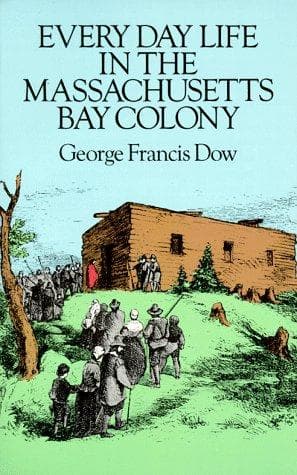
Every Day Life in the Massachusetts Bay Colony — John Shaqi
Every Day Life in the Massachusetts Bay ColonyDow, George Francis
History
Every Day Life in the Massachusetts Bay Colony
Dow, George Francis
Massachusetts -- Social life and customs -- To 1775
Early in the eighteenth century the walls of rooms in some
Massachusetts houses began to be covered with "painted paper"
hangings imported from England. These _papier paints_ were first
introduced into England, from France, about 1634, and probably were
brought into New England by Governor Andros and his followers.
Michael Perry, a Boston bookseller, who died in 1700, had in his
stock "7 quires of painted paper and three reams of painted paper."
His successor, Daniel Henchman, dealt in painted papers as appears
from his account books commencing in 1712. In 1713 two quires of
painted paper cost four shillings, and two quires of blue paper,
three shillings. In 1714, Isaac Thomas of Pembroke paid £2. 10. 0
for "6 Rowls Paint'd Pap'r & 2 Q'r Paper."
When Peter Sergeant of Boston died in 1714, the inventory of his
estate disclosed "one large gilt looking glass, in the cedar room,
£5. One suit of Imagery Tapestry hanging, £20. One suit of red china
£5." Two years later the house was purchased by the Provincial
Government for a governor's residence and in 1741 we find the
Provincial Treasurer paying Daniel Henchman £5. 8. 0. for four
rolls of painted paper and shortly another bill was presented for
"New Tacking the paper hanging above in the chamber & new papering
one roome below stairs."
In 1734, John Maverick, shopkeeper, bought of Henchman, four quires
and five sheets of painted paper for £1. 3. 9. In 1736, Colonel
Estes Hatch bought 10 rolls painted paper for £16. 5. 0. which
was probably used in his mansion in Dorchester, bought after the
Revolution by Colonel James Swan.
The painted paper of the eighteenth century was sold at first in
sheets, 22 by 32 inches, called elephant size. Later these were
pasted together to make 12 yard lengths. In the earlier stages of
manufacture the designs were colored by hand. Stencils of pasteboard
were used, and in the last half of the eighteenth century blocks
of pear and sycamore wood were used, as in calico printing. One
who painted coats of arms and other things pertaining to heraldry,
as well as one who painted or stained linen cloth, was known as a
"painter stainer." So, also, those who stained colored or stamped
paper for hangings were known as "paper stainers."
When Thomas Hancock built his house on Beacon Hill he desired
painted paper for some of his rooms. Extracts from his letter to
John Rowe, stationer, London, explain his wants:
Public-domain text, read in full here on John Shaqi.
Reviews
Reviews
No reviews yet
Be the first to share your thoughts on this work.
Join the Discussion
Join the discussion
Sign in to leave a comment or review.
Sign InorCreate an account