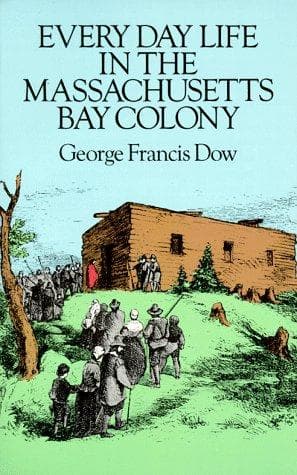
Every Day Life in the Massachusetts Bay ColonyDow, George Francis
History
Every Day Life in the Massachusetts Bay Colony
Dow, George Francis
Massachusetts -- Social life and customs -- To 1775
The chimney in the farmhouse was of great size, occupying relatively
a large amount of the space inside the house. The kitchen fireplace
usually was large enough to accommodate logs four feet in length,
oftentimes even larger. In making a fire a backlog, a foot or
more in diameter, was placed against the back of the fireplace; a
forestick was then placed across the andirons in front, and wood
piled between, producing a hot fire, and giving the kitchen a very
cheerful appearance. Large stones were sometimes used instead of a
backlog, and an iron bar was laid on the andirons in front of the
forestick. Ample ventilation was had by the constant current of air
that passed up the chimney.
In sitting before an open fire it was often complained that while
one was roasted in front he was frozen in the back and this led to
the use in nearly every family of a long seat made of boards called
a "settle," with a high back to keep off the wind from behind,
which, when placed before the fire, was usually occupied by the
older members of the family.
At night, any fire that remained was carefully covered with ashes
and was expected to keep until morning to kindle for the next day.
This was called "raking up the fire," and calculation was made to
have enough fire to cover up every night, so it need not be lost.
If the fire didn't keep over, some one would go with a fire pan to
a neighbor, if one lived near, and borrow some fire. But if this
was inconvenient, resort was then had to the tinder box. Tinder
was made by charring cotton or linen rags. The box containing this
was usually kept in a niche made in the side of the fireplace,
by leaving out a couple of bricks. By striking fire with flint
and steel, the tinder was ignited. Homemade matches, which had
been dipped in melted brimstone, were set on fire by touching the
burning tinder and in this way a fire was obtained. Sometimes fire
was kindled by flashing powder in the pan of a flint-lock musket,
thereby setting paper on fire. Friction matches did not come into
use until about 1832.
The cooking was done over and before the open fire. Boiling was
done by suspending kettles from pot hooks which were upon the crane
and of different lengths to accommodate the height of the fire. An
adjustable hook which was called a "trammel" was not infrequently
used. Meat was roasted by passing through it an iron rod called a
spit and this was rested on brackets on the back of the andirons in
front of the fire and by repeated turning and exposing on all sides,
the meat was evenly cooked. Another method was to suspend the meat
or poultry by a line before the fire. By twisting the line hard
it would slowly unwind. Of course some one had to be in frequent
attendance to twist the cords and usually it was a child. A dish
placed underneath caught the drippings from the roast. Sometimes
the line would burn off, and have to be replaced before the cooking
could be completed.
Public-domain text, read in full here on John Shaqi.
Reviews
Reviews
No reviews yet
Be the first to share your thoughts on this work.
Elsewhere in the archive
Join the Discussion
Join the discussion
Sign in to leave a comment or review.
Sign InorCreate an account