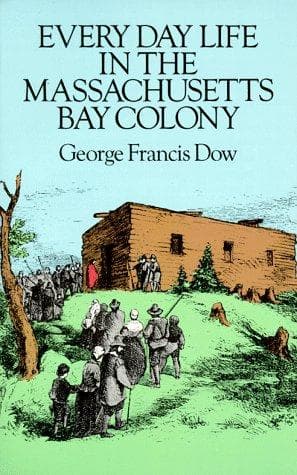
Every Day Life in the Massachusetts Bay ColonyDow, George Francis
History
Every Day Life in the Massachusetts Bay Colony
Dow, George Francis
Massachusetts -- Social life and customs -- To 1775
Potatoes and eggs were roasted in the ashes by wrapping them in wet
leaves or paper, and then covering with hot coals. In half an hour
or so the potatoes would be well cooked.
At first bread and other things were baked in a Dutch oven. It was
a shallow cast-iron kettle with long legs and a cover of the same
material, having a raised edge. The cover was filled with live
coals, and then the oven was suspended from a pot hook or stood
in the hot coals. It was used for both baking and frying. Indian
bannock, made from corn meal mixed with water and spread about an
inch thick on a board or wooden trencher, was baked before the fire
by setting it on an incline against a sad-iron or skillet, the top a
couple of inches back from the bottom, and when baked and made into
milk toast it was considered a dish fit to be "set before a king"!
The brick oven was in the chimney of nearly every well-built house.
The opening was inside the fireplace and was closed by a wooden
door. In heating the oven dry pine wood, which had been spilt and
seasoned out of doors for a short time and then housed, was a
necessity for the best results. The oven was considered hot enough
for a baking when the black was burned off the roof and the whole
inside had assumed a uniform light color. The coals and ashes inside
the oven were then removed with a "peel," a long-handled iron
shovel made for the purpose. The bottom of the oven was then swept
clean with a broom made of hemlock or other boughs. The process of
removing the fire and getting it ready for use was called "clearing
the oven."
The food to be cooked was then put in the oven: brown bread made
from rye and Indian meal, drop cakes made with milk and eggs and
wheat flour, which were placed directly upon the bricks and when
baked and eaten hot with butter, were considered a great luxury.
Beans, meats, potatoes, pies, and many other things were cooked in
the brick oven at the same time.
Families in good circumstances, made it a rule to heat the oven
daily, but Saturday was generally reserved for the week's baking.
The skins of animals killed on the farm were tanned by some local
tanner and a year or more was required by the old process, but it
produced an excellent quality of leather.
The utmost economy was practiced. Nearly all the young people and
some of the older ones went barefoot during the summer. In going to
meeting on Sunday the girls and young women often walked a number
of miles. They wore heavy shoes or went barefooted, carrying their
light shoes in their hands to save wear until near the meeting house.
Public-domain text, read in full here on John Shaqi.
Reviews
Reviews
No reviews yet
Be the first to share your thoughts on this work.
Elsewhere in the archive
Join the Discussion
Join the discussion
Sign in to leave a comment or review.
Sign InorCreate an account